← prelander teardowns

Side by side · CS-P2 kidney story

Our page on the right, word for word. The kept page on the left, part by part, described in our words, with a link that opens their live page at those lines (their text and pictures are not copied here). The plan under each of their parts was written from the teardown, before our page: where our page went another way, the right column is what stands. Mark each part and leave a note. It saves as you go, and a mark on a part of ours shows on every comparison of that page.
Compare CS-P2 with
Theirs

Native Bloom · one-narrator story

Kidney numbers keep sliding because every treatment polices what goes into the body while nobody clears the clogged drainage on the way out, and the industry paid to manage the slide has no reason to say so.

4,707 words · brand named 42% down the page · 3 buttons, the first at 86% · house chief 7/10 · craft chief REVISE

Open their live page ↗ · the full teardown

Ours

“Let's keep an eye on your kidney numbers,” my doctor said. So I read the research myself, and found what my kidneys are up against.

CS-P2 · angle CS-A03 · 2,790 words · version 2 (2026-09-29): rebuilt on the kept page's angle and order, in our own words. Both chiefs, round 2: 7/10 as drafted, 8.5/10 with the fixes (all 49 applied)

Open our live page ↗ · comment line by line in the Copy Studio

The order, at a glance

Each bar is one page from first word to last. Width is the share of the page's words. Click a block to jump to that part.

Theirs
brand named · 38%first button · 76%
Ours
astaxanthin named · 47%brand named · 63%first button · 70%
OpeningHer storyWhat she triedThe turnThe cause and the reason whyProofThe productResultsDoubts and limitsThe askThe close

What we took from this page

  • The order of the first 42 percent: stance, dated scene, itemized failed fixes, the shrug and the vow, the search, the hidden cause, one household picture, the recovery scene, a second case, and only then the name (entries 6 to 24).
  • Failed fixes as a ledger: one fix per line, the price she paid in her body, the result that did not move (entries 8, 9). It ends on the category the page is about to sell in.
  • A cause whose explanation walks back through the ledger and accounts for every failure (entry 13). The reader's own history becomes the evidence.
  • The recovery scene before the product, answered object for object against the opening scene (entries 7 and 14), with the object returning in the price passage and the postscript (entries 40, 57).
  • One sentence that compresses the argument and is repeated as a refrain (entries 14, 18). Twice is enough; they use it five times.
  • Price the alternative before pricing the product, as an itemized bill that adds up (entries 37 to 39), then give every discount a reason (entries 40, 41, 43).
  • The guarantee as a task: note a baseline on day one, look again on day thirty (entry 45). For us the baseline is how the reader feels, never a lab value.
  • Objections too small for the narrator's voice (effort, taste, one more pill) handled in a separate block after the letter (entries 59, 61). For us that block is a real FAQ.
  • Section rhythm for a phone: short head, then a clip or picture, then prose, usually under 200 words between two media rows and never more than about 330 (27 media rows across 4,700 words).
  • Proportion by words: story, cause and first proof 40 percent before the name; the name and the formula 8; proof block 7; price to guarantee 16; two roads, order steps and sign-off 16; thread 12.
  • A price ladder shaped like ours (one, buy two get one, buy three get two) presented as step two of a numbered procedure (entries 51, 52).

What we left on it

  • FABRICATION: the narrator. One doctor, with one wife and one story, signs as creator of two differently branded products on two stores. We never invent an authority figure (CL-14).
  • FABRICATION: every lab value, percentage, buyer count, return rate, stock count, order rate and case count. They serve two brands unchanged and several contradict each other on the same page.
  • FABRICATION: the 17-comment thread and the three starred testimonials, identical on both stores apart from the brand name.
  • The suppression story: a warning colleague, lawyers' letters, suppliers under pressure, hospitals that know and hide. Our villain is the wait between panels, and the doctor is an ally.
  • The call-out by race and the framing of an industry by the race of its owners. It targets a personal attribute and casts a group as the enemy.
  • Disease words and treatment claims: stages, the machine, lab values as promised outcomes, reversal, drugs named as failures, buyers said to have cut medication, a promise that any stage can be helped.
  • The prophecy of illness in the close (entry 50) and any line that frightens a reader about her own body to move her to the button.
  • The stack of deadlines and stock counts (entries 44, 51, 55, 56, 57). One true limit, stated one way.
  • The refill pitch (entry 53): we run no subscribe-and-save (r21 is false).
  • Their pictures in words: the drain, the tap and the sink, the assassins. The Cell Shield gets one picture of its own.
  • Their sentences. Nothing on our page shares a line with theirs.
  • The late button. Ours is available from the reveal onward through the sidebar card and the sticky bar.
  • The sag: formula cards that exist to complete a count, and outcome lines reused three times (entries 17, 27, 46).

Part by part · 29 paired · 13 theirs only · 23 ours only

I am
The headlinetheirs at 0% of the words · ours at 0%
Theirs, in our words
#2at 0%●●●●●h2 · 17 words

A doctor, identified by race and specialty, is said to expose a secret worth 73 billion dollars that a dialysis industry, identified by its owners' race, keeps from his own community.

Why it works. Stop one specific reader, tell her the writer is one of her own and on her side, and open a question (what secret?) large enough to carry 4,700 words. curiosity-gapcommon-enemyidentificationspecificityearned-authority

Why it sits here, and how it is written

It is the first sentence the eye reaches under the masthead. It assumes only that the reader already distrusts the system treating her. It supplies the enemy, the ally and the size of the prize at once, and that is what lets the deck get specific about a method without having introduced anyone.

Seventeen words, three named parties, one number. The verb is an expose verb, so the page is news before it is advice, and the trailing dots leave the sentence open. It calls the reader out by race and by medical condition, the kind of personal-attribute targeting ad platform policies restrict. UNVERIFIABLE: the dollar figure is never sourced anywhere below.

Planned for ours, before we wrote: rewritten to our claims. What transfers is one narrator reporting what they found, with the organ named. Ours is the CS-A03 hook: the doctor said to watch the kidney numbers, so the narrator did (hook H6, the doctor as ally). Recognition in the reader's own words comes first (CL-06). No expose, no industry, no call-out by race, no dollar figure. r10

See these lines on their page ↗
Ours, word for word
“Let's keep an eye on your kidney numbers,” my doctor said. So I read the research myself, and found what my kidneys are up against.
r10r1 row 0
The line under the headlinetheirs at 0% of the wordstheirs only
Theirs, in our words
#3at 1%●●●●○h2 · 43 words

Names the narrator twice over (a patient's husband and a kidney specialist), coins a name for the industry's alleged scheme, and promises a 21-day protocol that turned his wife's three-year lab climb around without three dreaded things.

Why it works. Convert the headline's outrage into a concrete payoff: a named method, a time frame, a proof case, and the three costs the reader most wants to avoid. specificityopen-loopearned-authorityhopeobjection-preempt

Why it sits here, and how it is written

It sits directly under the headline because the headline only names an enemy, and a reader who is angry but sees no way out leaves. The deck needs that enemy already in place so its coined scheme name has something to attach to. It also sets up the byline: the man described here is the man who signs the article two rows down.

One 43-word sentence, too long to say in a breath, yet every clause is a fact the reader can picture. The closing list of three avoided things ends on the one she fears most. Two promises made here are never paid: the coined scheme name does not return, and nothing below runs 21 days (the body gives 61, 34 and 30).

Planned for ours, before we wrote: rewritten to our claims. Keep the three-part shape: who is speaking, what they found, what it spared them. Ours: the narrator, the reframe that what protects kidney cells is fat-soluble and reaches the cell wall instead of adding work for the kidneys, and a 'without' list built from our reader's dreads (another shelf of bottles). No day-count we cannot support, no disease word, and every promise made here is paid below. r26m2r23

See these lines on their page ↗
Ours, word for word

Nothing on our page. The plan on the left says why.

The picturetheirs at 2% of the words · ours at 1%in a different place on their page
Theirs, in our words
#5at 2%●●●○○video · 0 words

A widescreen video sits between the byline and the first paragraph. The extract records its size only; a later comment speaks of a video that made the pitch, which suggests this is the letter in spoken form.

Why it works. Put a play button on the first screen and give readers who will not read a second way in. pattern-interruptease

Why it sits here, and how it is written

Placed after the stamps and before the prose so that the first screen holds headline, deck, signature and a moving picture. It asks nothing of belief. It holds the thumb long enough for the lead to start.

It sets the rule the whole page follows: section head, then a clip or picture, then prose. Eight clips and nineteen pictures keep a 4,700-word letter moving on a phone. No media row carries alt text, so nothing is described for a reader who cannot see it.

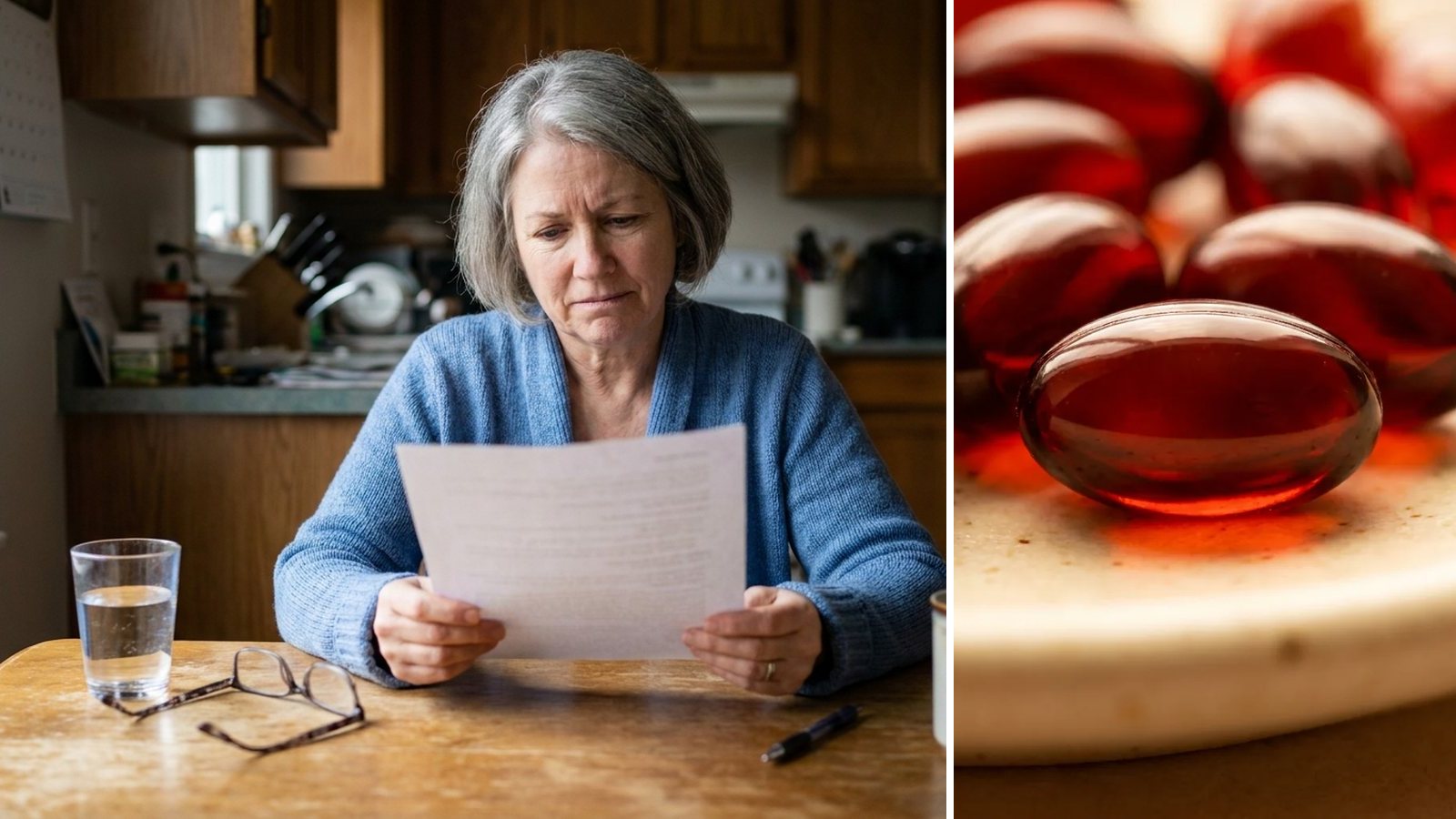
Planned for ours, before we wrote: kept the move. Our hero is the scene of the story: a kitchen table, a lab printout with the numbers blurred, reading glasses (hooks H8 and H3). First-party asset, with alt text written as customer copy.

Open on their page ↗
Ours, word for word
A woman in her sixties at a kitchen table reads a lab report. Beside her, a plate of deep red astaxanthin softgels.
Who is speakingtheirs at 1% of the words · ours at 1%
Theirs, in our words
#4at 1%●●○○○2× h2 · 16 words

A dateline with a to-the-minute timestamp and a six-figure view counter, then a byline giving the author's title and name.

Why it works. Make the article feel recent, widely read and signed by an accountable person. social-proofearned-authorityspecificity

Why it sits here, and how it is written

The deck has just described the author; the byline confirms him by name, and the counter says many others have read this, so reading on is normal. It must come before the first-person lead, because the 'I' that opens the body needs an owner.

The repeating-digit time and the exact count look measured, and the weekday is right for the date. FABRICATION: the same date, minute and view count sit on both stores' copies of the page, so none of them is a measurement. UNVERIFIABLE: the name carries no link, photo credit or affiliation.

Planned for ours, before we wrote: kept the move. Dateline and byline stay on our chassis. The byline is a real, operator-confirmed person or a composite disclosed in the footer (CL-14, L-07). The view counter is dropped: no invented counts.

See these lines on their page ↗
Ours, word for word
By Carol Whitfield · Retired school secretary, 66
What the page admitsours at 1%ours only
Theirs, in our words

Nothing on their page does this job here.

Ours, word for word
Ours alone. The kept pages present the narrator as a real person. Ours says she is a composite before the first claim, and again in the footer.
Sponsored. Carol is a composite character. Her story is drawn from what real people have written about their kidney numbers and about astaxanthin.
The opening sceneours at 2%ours only
Theirs, in our words

Nothing on their page does this job here.

Ours, word for word

I found out on a Tuesday, from a sheet of paper. My yearly blood panel had a flag on it.

My kidney numbers had moved the wrong way, and I felt fine. Nothing hurt. My body had not said a word.

r10 row 3

What finally explained that flag did not come from my doctor. It came from one paragraph in a kidney study, which I read at my kitchen table long after midnight.

I rolled my eyes the first time through. Then I read it twice more. I'll give you that paragraph in plain words further down, because it changed what I do every morning.

“That is me”theirs at 2% of the words · ours at 5%
Theirs, in our words
#6at 2%●●●●●h2 · 206 words

He says he is about to anger an industry and cost it a nine-figure sum, gives his wife's decline as the reason, names three signs the reader shares, promises five minutes, states his credentials and points to one day.

Why it works. Turn a headline reader into a story reader: take a side, show the motive, hold up a mirror, set a small time cost, prove the right to speak, and open the scene. common-enemymirroringearned-authorityidentificationopen-loopcommitment

Why it sits here, and how it is written

It stands between the stamps and the story because a scene about a stranger's wife would not hold a cold reader; first she must know whose side he is on and that the scene concerns her. The mirror comes only after his own motive, so it reads as shared trouble and not as diagnosis. The credentials come after the mirror, when she is asking who is speaking. The last sentence postpones the secret and makes the scene the price of hearing it.

One 206-word block doing six jobs, and it still reads fast: short sentences, paragraphs that end on trailing dots and pull the eye down. The mirror reuses the wife's own details (values rising at each test, the toilet in the morning, the word she dreads), recast in the second person. Race is invoked twice in this block. UNVERIFIABLE: the revenue figure and the 26 years of practice.

Planned for ours, before we wrote: rewritten to our claims. The inner order transfers: stance, personal motive, three reader signs, a small time promise, who is speaking, handoff to one day. Our mirrors come from the angle's problem words (numbers drifting, being told to watch it, the next blood test) as the reader's experience, never as a product claim. No industry losses, no race framing, no invented credentials (CL-14). r10

See these lines on their page ↗
Ours, word for word
I felt fine. So why had my kidney numbers moved?

I'm 66. I walk two miles most mornings. I gave up soda years ago, I drink my water, and I watch my salt.

I take what I'm prescribed, and I haven't missed a checkup in eleven years. Sit beside me at church and you'd never guess a thing.

What is at stake (theirs: the opening scene)theirs at 6% of the words · ours at 7%
Theirs, in our words
#7at 6%●●●●●2× h2 · img · 162 words

A dated, timed morning: his wife in tears on the bed over a lab sheet, two values printed, her wedding ring off a swollen hand, a call about preparing for the machine, and a specialist husband who cannot help.

Why it works. Make the reader feel the problem through one person, one object and one sheet of paper, and lower the narrator from expert to helpless husband. The four-word head promises a turning day; the picture under it rests the eye before the longest paragraph so far. story-transportspecificityidentificationfear-of-declinecandor

Why it sits here, and how it is written

It comes after the lead has promised a secret and before any explanation, because explanation lands only on a reader who is already feeling. The lead gave him rank; the scene takes it away, which is what makes his later discovery believable as need and not as salesmanship. The ring and the lab sheet are planted here so they can be paid back at entries 14, 40 and 57.

The best writing on the page. Clock time and calendar date open it; one-word and two-word sentences carry the shock; the dreaded thing is named first by the clinic's euphemism and then in two words. The ring on the nightstand shows swelling without a symptom list. UNVERIFIABLE: both lab values and the four-month drop are precise numbers nobody could check.

Planned for ours, before we wrote: kept the move. A dated, timed moment with one object transfers whole. Ours is the visit that ends with a re-test date and the printout folded into a pocket. The villain is the wait; the doctor stays an ally. No lab values printed, no disease stage, no machine. r10

See these lines on their page ↗
Ours, word for word

So I sat at my kitchen table with that sheet in my hands, and I felt cheated. If this happens to people who do it right, why do it right?

A sore knee tells you. A bad tooth tells you. Kidneys say nothing, so you find out from a number that has already moved.

The doctor's answerours at 9%ours only
Theirs, in our words

Nothing on their page does this job here.

Ours, word for word
The plan for my kidney numbers: “Let's keep an eye on it.”

My doctor is a good one, and I've seen her for eleven years. She read the sheet and said we'd keep an eye on it. We'd test again in six months.

I had brought a list of questions. I left with a date on a card.

I don't blame her. Watching is her job, and she does it well. But six months is a long time to do nothing about a thing you can't feel.

What she already triedtheirs at 9% of the words · ours at 12%
Theirs, in our words
#8at 11%●●●●○video · h2 · 2× p · 53 words

After a clip, a one-line header says he used everything his training offered; the first two items are prescription drugs, each given with its dose, the bodily price his wife paid, and the lab value that kept falling anyway.

Why it works. Disqualify the standard medical route by showing it was tried properly, by an expert, on someone he loved. contrastspecificityearned-authoritymirroring

Why it sits here, and how it is written

It follows the scene at once, while the reader is still asking why a kidney doctor could not fix this. The list answers before the question hardens into doubt about him. It has to precede the hidden cause: a new cause is only needed once every known fix has been crossed off.

A ledger, not a paragraph: name and dose, then a small physical scene (a kerb, a bathroom floor at two in the afternoon), then the number that ignored it. The doses make it read like a chart. Listing prescription drugs as failures is advice against medication by implication.

Planned for ours, before we wrote: rewritten to our claims. The ledger format transfers: one fix per line, what it cost, the result that did not move. Ours lists what our reader tried without a doctor: the daily multivitamin that is underdosed and does not reach cells, and the shelf of single bottles. No prescription drug is ever listed as a failure. r3r23

See these lines on their page ↗
#9at 12%●●●○○3× p · 54 words

Three more crossed-off fixes: cutting salt, a diet stripped of potassium and phosphorus (three foods named), and kidney supplements (three herbs named), each ending on a sign or number that went the wrong way.

Why it works. Extend the failure from the clinic to the kitchen and the supplement aisle, so the reader's own efforts are covered and the product's own category is dealt with in advance. vindicationmirroringspecificityobjection-preempt

Why it sits here, and how it is written

These three come after the drugs because they are what the reader herself did; the list moves from the doctor's tools to hers. The supplement line is last on purpose. The page is about to sell a supplement, so ordinary supplements must fail first, by name, to leave room for a different kind.

The foods are chosen for the community the page addresses, which makes the sacrifice felt. The salt line gives the foam a will of its own, a small flash of voice. The last line dates the failure by the end of a bottle, the unit the reader will later be asked to buy.

Planned for ours, before we wrote: rewritten to our claims. Keep the move from the expert's tools to the reader's own, ending on the category we sell in. Ours: water-soluble vitamins that stay in the blood and add kidney work, and the energy drinks and powders that add oxidative load. Ordinary antioxidants fail last, by type, to make room for one that reaches the cell. r5r26r25p3

See these lines on their page ↗
Ours, word for word
What I tried for my kidneys while I waited

I went home and did what people do. I tried harder.

More water. Eight glasses a day, then ten. I was up all night, and that was the only thing that changed.

Less salt. I read every label in my kitchen. Dinner got dull. And I had no way to know if my kidneys noticed.

A multivitamin, because the bottle said “complete.” Then a kidney blend with nine herbs I could not pronounce. Forty dollars a month, to feel like I was doing something.

“That is me”ours at 15%ours only
Theirs, in our words

Nothing on their page does this job here.

Ours, word for word

Then an email would come from the patient portal, and I'd feel it in my stomach before I read a word. I doubt I'm the only one who opens those with one eye shut.

Proof: other peopletheirs at 29% of the words · ours at 17%in a different place on their page
Theirs, in our words
#19at 31%●●●●○3× h2 · video · 105 words

A second case: a colleague's brother, eleven years at stage 4, told to prepare for access surgery, two lab values and his total spend given; 34 days on the protocol he phones with a higher value his doctor retested.

Why it works. Prove the wife was not a one-off by repeating the result in a stranger who was worse off, and have a doctor's disbelief vouch for the number. The head keeps the enemy in frame; the clip opens the proof section. social-proofspecificityborrowed-authoritystory-transporthope

Why it sits here, and how it is written

One recovery by the narrator's own wife invites the thought that love and luck did it. The second case comes straight after the argument is complete and before the product is named, so the proof attaches to the idea of clearing and not to a bottle. His worse starting point tells the reader at a late stage that she is not too far gone.

Told in dialogue, which keeps it moving; the clinic's euphemism for surgery is used unexplained, as insiders would. The result arrives as a pull quote in the patient's own voice. The detail that the doctor ran the test twice is the persuasive part: disbelief from authority is stronger than praise. UNVERIFIABLE: the man, his values and his spend.

Planned for ours, before we wrote: our proof in its place. A second voice after the narrator, worse off at the start. Ours is a real customer in a senior voice or the longevity doctor's quote. No lab values, no stage, no retest story. The angle's research file holds real first-person voices to draw from. r19r17

See these lines on their page ↗
#20at 34%●●●○○h2 · 79 words

Within eight weeks strangers seek him out, in three named groups including people with diabetes; he claims all of them improved, in a sentence broken into single words, rejects the clinic's modest vocabulary, and ends by announcing that threats began.

Why it works. Widen two cases into a crowd so the reader can find her own type in it, then hook into the persecution story. social-proofconsensusidentificationopen-loopcontrast

Why it sits here, and how it is written

Two cases are anecdotes; the crowd makes it a pattern, and the three groups are chosen so that the diabetic and the thrice-dismissed reader each see themselves. The universal claim is placed at the exact point where disbelief peaks, and the last line turns that disbelief into a question about who would want this stopped.

The one-word-per-sentence line is emphasis by punctuation, a device that reads as shouting. The rejection of the clinic's phrases is one more contrast flip. A claim that nobody failed to improve is the least believable sentence on the page, and the writer seems to know it, since the threat hook follows at once to change the subject. UNVERIFIABLE: the crowd and its results.

Planned for ours, before we wrote: rewritten to our claims. The widening from one case to many transfers, and so does a last line that pulls into the next section. A universal result claim does not. Our widening is the size of the research base and the readers we serve, men and women in their 60s and 70s. r14i2

See these lines on their page ↗
Ours, word for word
I wasn't the only one with kidney numbers like mine

One night I couldn't sleep. I carried my laptop to the kitchen table and typed my question into a search box.

I landed on a message board. Page after page, people I had never met were writing out my own thoughts.

A man of 71 who walked every day. A retired nurse. A woman younger than my daughter.

What she already tried (theirs: the doctor's answer)theirs at 12% of the words · ours at 19%
Theirs, in our words
#10at 13%●●●●○h2 · 139 words

Nothing held; her own specialist at a named hospital kept adjusting and monitoring while she slid a full stage in under two years. He sketches who she is, says something in him broke, and vows to solve it himself.

Why it works. Name the shrug the reader has heard in her own appointments, turn managed decline into the insult, and hand the narrator a mission. common-enemyidentificationvindicationstory-transportopen-loop

Why it sits here, and how it is written

Only after the fix-by-fix ledger can the page say the experts were no better, because the reader has just watched the expert's tools fail. The portrait of the wife comes here, not in the scene, so that the vow is made for a whole person. The vow must come before the research so that the counts in the next entry read as devotion.

The clinic's own phrase is repeated and then turned against it in one dry sentence, the sharpest line in the first half. The portrait is three facts, each a role in her community. The car-payment jibe at an executive is where grief tips into grievance; it returns at entry 50.

Planned for ours, before we wrote: kept the move. This is our angle's own villain: the visit that ends with a re-test date. On our page the doctor is right and stays an ally; what is blamed is the six months of waiting. The vow becomes the hook's second half: told to watch the numbers, the narrator does, and goes looking for what can be done between panels. r10

See these lines on their page ↗
Ours, word for word

They were kind to each other, and I was glad of the company. But by the third page I saw what was missing. Everybody had the worry. Nobody had the reason.

The turntheirs at 15% of the words · ours at 20%
Theirs, in our words
#11at 16%●●●○○2× h2 · video · 103 words

A research montage in counted units (days, studies, researchers phoned, countries, two conference cities, retirement money spent), ending on the charge that the field rests on a deliberate falsehood, and on two things the illness is not.

Why it works. Earn the right to contradict medicine by showing the price paid to find out, then clear away the two explanations the reader has been given. The seven-word head promises a finding; the clip separates the vow from the search. earned-authorityspecificityopen-loopcommon-enemypattern-interrupt

Why it sits here, and how it is written

It follows the vow because a vow with no labor is only anger. The counted effort has to come before the new cause so that the cause arrives as a finding. The two denials come last: they empty the slot the reader's doctor filled, and the next entry fills it.

Numbers stacked without commentary; the sum taken from retirement savings is the emotional one. The wish to bin his diploma gives the turn a gesture. Nothing is cited: no study, researcher or conference is named. UNVERIFIABLE: every count here. The day count (94) disagrees with the one at entry 16 (81).

Planned for ours, before we wrote: rewritten to our claims. The narrator going to look transfers, with the effort made visible. Ours rests on real literature: the body of clinical studies on astaxanthin, and one real PubMed or NIH record shown as a screenshot in this chapter (the house rule for investigation pages). No invented counts, no charge of deliberate lying. r14

See these lines on their page ↗
Ours, word for word
The night I read the kidney research for myself

So I left the message board and went looking for the studies themselves.

I read slowly, with a dictionary open in another window. I did not follow all of it. I followed enough.

All my effort had gone into my plate and my water glass. The research was about something smaller, the kidney cell itself.

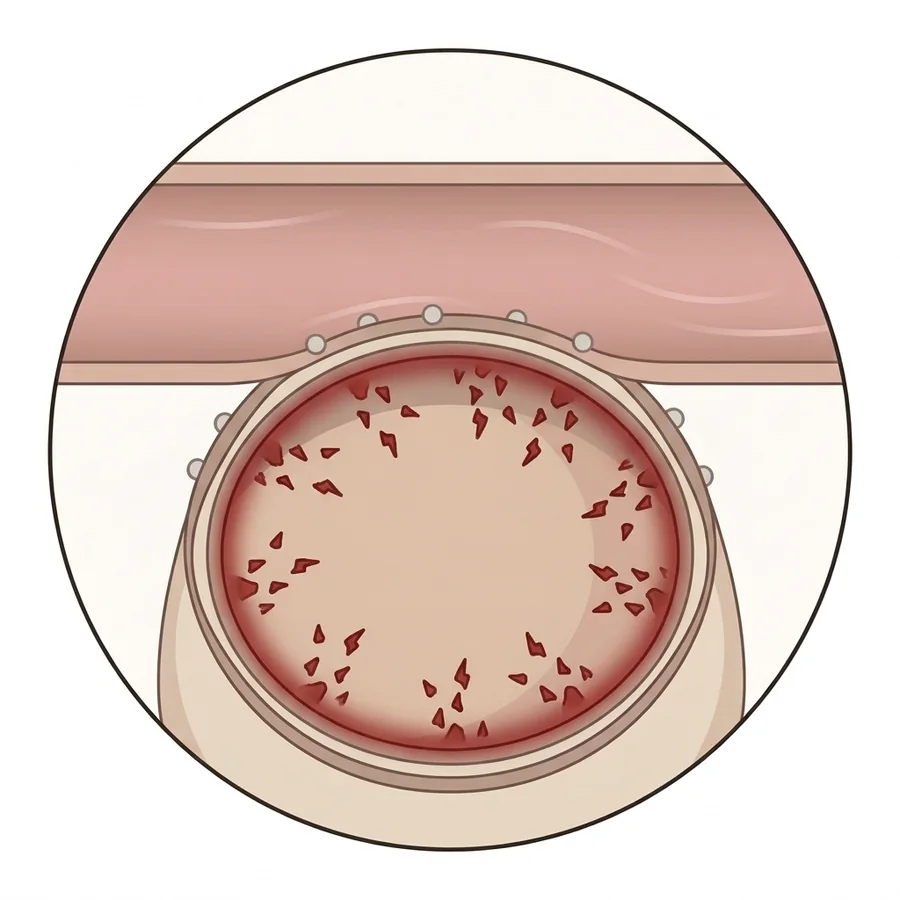
Here's the picture I wish somebody had drawn for me that first Tuesday.

A drawing of one cell. Small red marks of wear gather along the inside of the cell wall.
Where the wear gathers: along the inside of the cell wall.
The causetheirs at 17% of the words · ours at 23%
Theirs, in our words
#12at 18%●●●●○2× h2 · 78 words

A display line recasts kidney decline as an invasion by toxic buildup; the prose says two famous hospitals and the reader's own specialist know it and stay silent, the true cause being too simple and cheap to fix.

Why it works. Replace the diagnosis the reader was given with a new cause that is physical, outside her fault, and removable. new-mechanismcommon-enemyborrowed-authorityvindicationreason-why

Why it sits here, and how it is written

It lands the moment the old explanations have been denied, when the reader holds a question and no answer. It needs the enemy from the headline already in place, since the claim that institutions know and hide it is what explains why she never heard this. It names the cause in one word so the next entry can spend its length on how it works.

The display line is fourteen words with one capitalized noun, built to be the screenshot. The institutions are borrowed as witnesses without a single quotation: they are said to know, which cannot be checked. The paragraph ends by returning to the display line's image, a closing echo that works.

Planned for ours, before we wrote: our own explanation in its place. Our hidden cause is reactive oxygen from modern food and modern life wearing on kidney cells, plus the blindspot: vitamin C works outside the cell and vitamin E on its surface, so the inner wall stays exposed. No institution is accused of hiding anything. Nobody kept it from the reader; most people have simply never heard of astaxanthin. r1p3p7

See these lines on their page ↗
Ours, word for word
What wears on your kidneys as you age

All day long, your body makes unstable oxygen molecules. They come from food, from stress, from being alive. They knock into your cells and wear them down, a little at a time.

r1 row 33

When you are young, your body cleans up after them. After 50, the cleanup falls behind.

r1 row 34

Doctors call that wear oxidative stress. It works the way rust does. Slowly, and without a sound.

r1 row 35

Your kidneys filter your blood around the clock, through vessels thinner than a hair. That much work means that much wear, and the lining of those vessels takes it.

r1r10 row 36
Proof: the researchours at 27%ours only
Theirs, in our words

Nothing on their page does this job here.

Ours, word for word
PubMed record: The aging kidney: role of endothelial oxidative stress and inflammation. Csiszar A, Toth J, Peti-Peterdi J, Ungvari Z. Acta Physiologica Hungarica, 2007.
On PubMed: a review of the part that oxidative stress and inflammation in the lining of blood vessels play in the aging kidney. PMID 17444279.

That is the study. The paragraph I promised you is written for scientists, which is why I rolled my eyes. In plain words, the authors make this case. As we age, oxidative stress in the blood vessels has a large part in how a kidney changes.

r1r10 row 38
The doctor's answerours at 29%ours only
Theirs, in our words

Nothing on their page does this job here.

Ours, word for word

In eleven years of checkups, I had never heard those two words. Nobody was hiding them from me. A fifteen-minute visit can only hold so much.

The reason whytheirs at 19% of the words · ours at 30%
Theirs, in our words
#13at 20%●●●●●2× h2 · video · 179 words

The explanation: kidneys drain waste through their own small vessels; residue from filtering 50 gallons a day hardens over decades and blocks them like a clogged household drain, which no drug, diet or machine clears.

Why it works. Give the new cause a picture the reader already owns, tie each of her three signs to it, and explain in one stroke why every fix in entries 8 and 9 failed. The head promises the hidden root; the clip gives the eye a rest before 173 words. new-mechanismreason-whyspecificityvindicationloop-closed

Why it sits here, and how it is written

The cause was named one entry ago and would be a slogan without this. It needs the failed-fix ledger behind it, because its last lines walk back through that ledger and explain each failure. It must come before any result or product: the recovery at entry 14 is only believable, and the product at entry 24 only necessary, if the drain picture is already in the reader's head.

It opens by promising plain terms and keeps the promise: tubes, waste, a drain. The build over time is done in three beats (a day, a month, decades), then three verbs for the residue. A plumbing picture every homeowner has lived. The biology is fitted to the product. The craft is in how the last four sentences turn the reader's past failures into evidence.

Planned for ours, before we wrote: our own explanation in its place. This slot is The Cell Shield: astaxanthin spans the whole wall of the cell, reaches kidney cells, adds no extra work for the kidneys because it is fat-soluble, and restores flow in the smallest vessels. One household picture of our own, taught before the noun appears (CL-07), and the same paragraph must explain why the fixes in our ledger fell short. The word mechanism never appears in the copy (CL-02). m2r10r26m5p3

See these lines on their page ↗
Ours, word for word
Why my vitamins never reached my kidney cells

What I read next sent me to my kitchen counter, to look at every bottle I owned.

The wear starts inside the cell, and no glass of water can rinse in there.

p3 row 42

Vitamin C stays in the fluid around the cell, and vitamin E settles on the surface of the cell wall. Neither one guards the inside.

p3 row 43

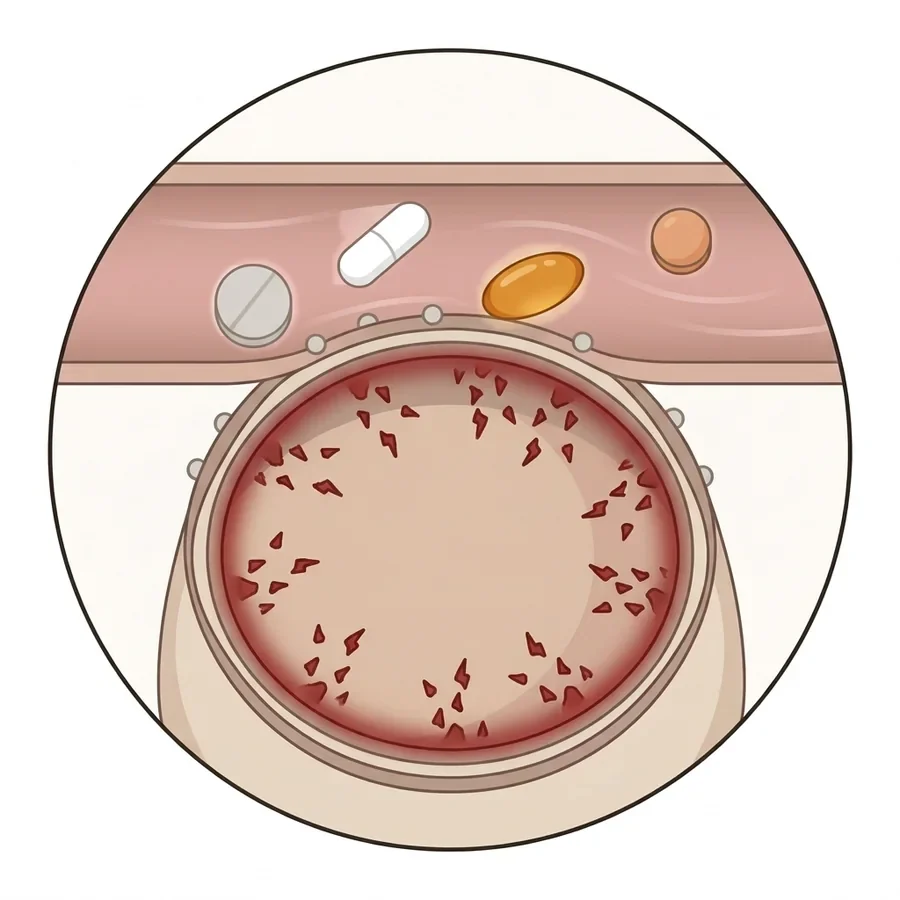
Most pills never get even that far. They ride around in your blood. The water-soluble ones get filtered and flushed by the same kidneys you're trying to help.

r5r26 row 44

It's like waxing a car door that's rusting from the inside. The wax is real. It's just on the wrong side.

p3 row 45

By two in the morning I had my own name for it. Rust on the inside. Once you've pictured it, you never look at a vitamin bottle the same way.

p3 row 46
A drawing of a blood vessel beside one cell. Four ordinary pills drift past in the blood. Inside the cell, the red marks of wear are still there.
Ordinary vitamins ride along in the blood. The inside of the cell stays open.
What happens, week by weektheirs at 22% of the wordstheirs only
Theirs, in our words
#14at 24%●●●●●4× h2 · video · 136 words

A callback to the bedside scene, then the payoff: 61 days on, his wife hosts a church dinner for 22, five hours standing, ring on. One change did it: every expert policed intake, none asked about outflow.

Why it works. Pay off the scene with its mirror image before the product exists, so the reader wants the change before she can judge the thing. The head calls it a miracle that was in view all along; the clip marks the turn from cause to cure. loop-closedstory-transporthopeopen-loopcontrast

Why it sits here, and how it is written

It comes after the cause and before the product by design. With the drain picture in place the recovery needs no proof beyond logic, and with no product named there is nothing to be skeptical of yet. The ring planted in entry 7 returns here. The closing reframe about intake and outflow is the hinge of the page; everything after it is about clearing.

The after-scene answers the before-scene object for object: bed to dinner table, ring off to ring on, tears to laughter. Three negations list what she no longer needs, which doubles as a claim that she came off medication. His embarrassment at how simple it was is the one imperfect beat, and it makes him human. Counting forward from the scene's date (94 days of research, then 61 more) puts this holiday dinner in early August.

Planned for ours, before we wrote: rewritten to our claims. The move transfers: the after-scene arrives before the noun, and the scene's object returns. Ours shows what the gate holds: steady energy through the day within the first weeks, staying active and independent. No claim of stopping medication, no reversal, no lab value. r7r24

See these lines on their page ↗
Ours, word for word

Nothing on our page. The plan on the left says why.

What she already triedours at 35%ours only
Theirs, in our words

Nothing on their page does this job here.

Ours, word for word
Everything I had tried for my kidneys, looked at again

Once I knew where the wear starts, my whole list made sense.

The water and the salt. Good habits, and I've kept both. The water rinsed my blood, but it couldn't rinse the inside of a cell. The low-salt dinners were good for my blood pressure, and that was their whole job.

r5 row 50

The multivitamin and the herbs. The multivitamin was mostly water-soluble, so my kidneys had to filter it out. The nine herbs were nine more things for them to handle.

r26r3 row 51

The vitamin C and the vitamin E in my multivitamin. Real antioxidants, and I still take them. Good as they are, both stop at the door. Every bottle on my counter was wax.

p3 row 52

I don't regret one of those bottles. Each one did the job it was built for.

“That is me”ours at 40%ours only
Theirs, in our words

Nothing on their page does this job here.

Ours, word for word

Now I'll tell you something I had never said out loud. When that number moved, I thought it was me. A dinner out. A walk I skipped. Some weakness of mine.

That night, at my kitchen table, with a cup of tea gone cold, I felt my shoulders come down. It was the first time in months.

The causeours at 42%ours only
Theirs, in our words

Nothing on their page does this job here.

Ours, word for word
My kidney numbers were never about how hard I tried

The whole thing was about where my trying could reach.

p3m2 row 57

For months I thought I was failing. I was not. I had been waxing the outside of a door that rusts from the inside. I'll admit I was a little cross about all that blame.

The turnours at 44%ours only
Theirs, in our words

Nothing on their page does this job here.

Ours, word for word

By breakfast I had a new question. What works from the inside?

The reason whytheirs at 25% of the words · ours at 45%
Theirs, in our words
#15at 27%●●○○○4× p · 25 words

Four short lines restate the cause as a chain: buildup in the kidney's drainage vessels, drainage blocked, waste backing into tissue, every lab value pushed the wrong way.

Why it works. Give skimmers the whole cause in a form they can read in three seconds. reason-whynew-mechanismease

Why it sits here, and how it is written

Placed straight after the reframe so that the reader who skipped the long explanation at entry 13 still carries the chain into the solution. It ends on the lab values because that is what the reader measures her life by, and the next entry opens on the fix.

Each line is a participle phrase trailing into dots, so the four read as one falling sentence. It adds nothing new. It is a recap for the thumb-scroller, and it works as one.

Planned for ours, before we wrote: our own explanation in its place. A four-step chain in our terms as a scannable list, organs named (CL-04): reactive oxygen from modern life, ordinary antioxidants stopping at the outside of the cell, the inner wall left exposed, the kidney cells taking the wear. r1p3m2r10

See these lines on their page ↗
#16at 28%●●●●○h2 · 104 words

The fix is clearing the way out, not limiting intake; he drops drugs for natural compounds and after 81 days has six: some from old traditions, some from modern kidney research, never before combined, fast-acting once the blockage clears.

Why it works. Turn the cause into a shopping specification: a kind of thing (natural, several compounds, combined) that no pharmacy or supplement shelf holds. new-mechanismreason-whyexclusivityopen-loopborrowed-authority

Why it sits here, and how it is written

The reader now believes in the blockage and has seen the after-scene, so she is asking what the one change was. This entry answers with a category, not a name, which moves her from knowing the problem to knowing what a solution must look like. The count of six sets up the six cards at entries 27 to 32.

It opens on the intake and outflow contrast for the second time in two entries; by entry 25 it will have been said five times and become a refrain. The pedigree is split between tradition and science so both kinds of reader are covered. The claim of clinical documentation stands in for any document. The day count contradicts entry 11.

Planned for ours, before we wrote: our own explanation in its place. Our specification is one ingredient, not six: fat-soluble, spanning the cell wall, the natural microalgae form used in the human studies, at 12 mg. One softgel instead of a shelf of bottles is itself the contrast. m2r26c4b7r23

See these lines on their page ↗
Ours, word for word
What the right nutrient would have to do for a kidney cell

So I wrote down what I was looking for. Three things.

It had to reach the inside of the cell, where the wear starts. It had to guard the cell wall on both sides, inside and out. And it couldn't be one more thing for my kidneys to filter.

m2r26 row 62

That last one ruled out almost everything on the shelf.

The scene aheadtheirs at 28% of the wordstheirs only
Theirs, in our words
#17at 30%●●●○○4× p · 42 words

Four one-line outcomes in the second person, ordered from the bathroom to the calendar: the morning foam is gone, energy lasts past mid-morning, lab values improve for once, and days stop being planned around tiredness.

Why it works. Let the reader try on the result in her own body, sign by sign. future-pacingmirroringhopespecificity

Why it sits here, and how it is written

It answers the promise of speed that closed entry 16, and it takes the signs from the lead's mirror (the foam, the lab values) and turns each around. It has to come before the product is named. She agrees to the outcomes first, and the bottle later inherits that agreement.

Times of day make it concrete, and each line is short enough to be read as a caption. The third line promises a lab result, which is a medical outcome promise however softly it is phrased.

Planned for ours, before we wrote: rewritten to our claims. Keep a list that turns the mirror around line by line. Ours: energy with no noon crash in the first two weeks, a clearer head, and the kidney-numbers line only as the gate words it. The foam line rests on a claim that is cleared but flagged, so it is used with care or left out. r7r6r10r11

See these lines on their page ↗
Ours, word for word

Nothing on our page. The plan on the left says why.

The turnours at 47%ours only
Theirs, in our words

Nothing on their page does this job here.

Ours, word for word
The red nutrient that kept coming up as I read about my kidneys

The same pigment kept showing up in the papers I read. It's deep red, and a tiny freshwater algae makes it. Wild salmon get their color from it.

r15c4 row 65

It had a name I had to practice. Astaxanthin. You say it asta-ZAN-thin.

The reason whytheirs at 29% of the words · ours at 49%
Theirs, in our words
#18at 30%●●●○○h2 · 19 words

A two-sentence display line denies that the list above is a pledge and calls it simple consequence, compressing the whole argument into intake versus drain.

Why it works. Make the outcomes feel like physics, not salesmanship, and leave one portable phrase in the reader's head. reason-whycontrastobjection-preempt

Why it sits here, and how it is written

It closes the section that began at entry 14, straight after the most promise-like lines on the page, which is where a reader would think that this is a big promise. It gets there first. With the argument compressed to one phrase, the page can leave explanation and move to other people's results.

The denial is a contrast flip, the page's favorite shape, and it disclaims a promise while making one. As a section-ending line it does what a last line should: it carries the point out of the section in a form that can be repeated.

Planned for ours, before we wrote: our own explanation in its place. One plain line that compresses our reframe: water-soluble vitamins pass through, astaxanthin reaches the kidney cells (hook H7). Said straight, with no flip, and it never disclaims a promise it is making. r26m2r10

See these lines on their page ↗
Ours, word for word

Astaxanthin is a long molecule, long enough to lie across the whole cell wall. One end rests on the outside. The other end rests on the inside.

m2 row 67

So it guards the inside, where the rust starts and my vitamins never reached. It guards the outside as well. It also reaches the eyes and the brain.

m2r5r6b3 row 68

When I first read that, it sounded too tidy to be true. So I kept reading.

Proof: the researchtheirs at 43% of the words · ours at 51%in a different place on their page
Theirs, in our words
#27at 45%●●●○○img · h2 · 3× p · 75 words

First card, astragalus root, with a square picture: a heritage line (emperors, two thousand years), a 2019 study said to show it clears what smothers the kidneys, then what she may notice within weeks: better labs, energy past noon.

Why it works. Set the card pattern (old use, modern study, felt result) and put the strongest ingredient first. The square thumbnail makes each card a unit the eye can count. borrowed-authorityspecificityfuture-pacingreason-why

Why it sits here, and how it is written

The first card gets the most lines because it teaches the reader how to read the other five. It leads with tradition, since the reader was told at entry 23 that her ancestors used these; the study year follows to satisfy the skeptic; the felt result comes last so the card ends on her and not on the herb.

Three sentences, three kinds of proof. The heritage line comes from another continent than the ancestors promised at entry 23. The felt result repeats entry 17 almost line for line. UNVERIFIABLE: the study has a year and no author, journal or link.

Planned for ours, before we wrote: our proof in its place. The three-part card transfers: where it comes from, what the research shows, what the reader notices and when. Ours: natural microalgae, the clinical study base with a real citation shown, steady energy in the first two weeks. c4r14r7

See these lines on their page ↗
#28at 46%●●●○○img · h2 · 3× p · 51 words

Second card: cleavers, with a 2020 study and a footnote mark, said to flush the kidney's clogged vessels. A kitchen analogy assigns the first herb the tap and this one the sink; a bridge line turns to inflammation.

Why it works. Show the ingredients work as a team, each with a role, using one picture from the kitchen. borrowed-authorityreason-whyspecificityopen-loop

Why it sits here, and how it is written

It is second because it matches the page's coined cause most literally: the cause is a blocked drain and this is the herb said to flush. The pairing analogy can only come once two cards exist. The bridge line keeps the narrator's hand visible, so the list still reads as his investigation.

The analogy is the second household picture on the page and extends the first (drain, now tap and sink), which is disciplined. Footnote marks appear here and on the next card, numbered 5 and 7, and no footnote list appears in the extracted page: the marks are decoration left over from a longer source. UNVERIFIABLE: the study.

Planned for ours, before we wrote: our proof in its place. The slot for a paired picture belongs to our comparison: vitamin C guards outside the cell, vitamin E its surface, astaxanthin the full thickness, with the measured quenching power beside it. Any footnote mark on our page resolves to a real source. m2p3m3

See these lines on their page ↗
#29at 48%●●○○○img · h2 · 2× p · 49 words

Third card: red clover, with a 2017 study, a second footnote mark and a coined scientific-sounding adjective, said to calm the vessel walls so fluid drains freely. A closing line says he topped the formula off with several more compounds.

Why it works. Cover inflammation, the third leg of the formula story, and move the reader on to the remaining three. borrowed-authoritynew-mechanismspecificity

Why it sits here, and how it is written

It is third because it handles what is left once the inflow is cut and the drain is flushed: the irritated walls. After it the page has spent its real argument, and the bridge line admits as much by bundling the last three cards as extras.

The coined adjective is set in quotation marks, which flags it as a term of art and hides that it is not one. The bridge line is filler: a stock phrase about raising the formula a level, which tells the reader the next three cards matter less. This is where the page starts to sag. UNVERIFIABLE: the study.

Planned for ours, before we wrote: our proof in its place. A third proof slot, for blood flow in the smallest vessels so that nutrients reach the organs. No coined pseudo-scientific term; every term is taught in its own sentence (CL-07). No bridge line that demotes what follows. m5

See these lines on their page ↗
Ours, word for word

It held up. There are more than 60 clinical studies on astaxanthin. In lab tests it has 6,000 times the power of vitamin C against one kind of unstable oxygen.

r14m3 row 70
What the research said about kidney cells, and what it didn't
The reason whytheirs at 42% of the words · ours at 53%in a different place on their page
Theirs, in our words
#26at 44%●●○○○h2 · 22 words

A 22-word head states the count (six natural ingredients) and the two things they are said to do: dissolve the buildup and bring back filtering.

Why it works. Open the formula section with the promise restated, so each card below reads as a part of one job. new-mechanismspecificity

Why it sits here, and how it is written

It follows the handoff line and pays off the count planted at entry 16. It restates the two verbs of the cause so that the six cards need not each argue it again.

Too long for a head and set in title case, so it reads as a label. The count is the hook. The two verbs are treatment claims.

Planned for ours, before we wrote: our own explanation in its place. We have one active, named with its dose and what it does for kidney cells in the scannable layer (CL-04). The active is named; the rest of the panel is only what holds the softgel together. m2r10b7

See these lines on their page ↗
Ours, word for word

I had stayed up that night for my kidneys. They do all that filtering through vessels thinner than a hair, and kidney cells were where I wanted a guard.

r10 row 72
Proof: the researchtheirs at 47% of the words · ours at 54%in a different place on their page
Theirs, in our words
#31at 50%●○○○○img · h2 · p · 16 words

Fifth card: calendula, with a 2017 study said to show better circulation and less fluid retention across the body. One sentence, no tie to the kidneys.

Why it works. Fill out the count of six and touch the swelling the scene showed. borrowed-authorityspecificity

Why it sits here, and how it is written

It is fifth of six, where attention is lowest. It links back to the swollen hand of entry 7 only by implication, and nothing later depends on it.

The flattest line on the page: a study year, a general benefit, no picture in the words, no reader. It reads like a line from a supplier's sheet. UNVERIFIABLE: the study.

Planned for ours, before we wrote: left out. Does not transfer. We sell one active, and a card that exists to complete a count is padding. Nothing stands here.

See these lines on their page ↗
Ours, word for word

One more finding, and I want to be careful with it. In lab work on kidney cells, astaxanthin also switched on the cell's own defenses. That was cells in a lab, not people. I still thought it was worth knowing.

r10b4 row 73
The turnours at 55%ours only
Theirs, in our words

Nothing on their page does this job here.

Ours, word for word

That was enough for me. I'd keep doing everything my doctor asked, and I'd add one thing of my own.

b9r10 row 74

All I wanted was something I could start on a Monday morning, without waiting six months to begin.

The doubt, answeredtheirs at 33% of the words · ours at 57%
Theirs, in our words
#21at 35%●●●●○2× h2 · img · 139 words

A colleague of 14 years warns him to stop; legal letters from two firms follow, none disputing the results; he recasts himself as a Howard-trained Black physician who solved what the industry ignored, and opens a list.

Why it works. Answer the unspoken question (if this works, why has nobody told me?) by making opposition itself the evidence, and bind the narrator to the reader's community. The head names the dollar figure a second time; the picture opens the section. common-enemyobjection-preemptidentificationexclusivitystory-transport

Why it sits here, and how it is written

It follows the universal claim because that is where the reader thinks the claim is more than she can believe. The story converts her doubt into proof: powerful people are said to be afraid, and their lawyers are said never to contest the results. It comes just before the product so that the bottle arrives as something nearly forbidden.

The warning is delivered in a friend's voice, which is more menacing than a threat. Then a slip: the colleague is given a woman's name and a man's pronoun one line later, the mark of a story assembled from parts. FABRICATION: no firm, letter or date is shown, and the same colleague and the same letters appear under another brand on the other store.

Planned for ours, before we wrote: rewritten to our claims. The objection is real and transfers: why has my doctor never mentioned this? Our answer is plain and true: most of this market has never heard of astaxanthin and buys other things. No persecution story, no invented colleague or lawyers, nobody cast as an enemy. p7

See these lines on their page ↗
Ours, word for word
“Isn't that one more pill for my kidneys?”

That was my first question too. I had read the stories about supplements being hard on kidneys.

The answer is in how it dissolves. Most supplements dissolve in water, so your kidneys filter them and flush them. Astaxanthin dissolves in fat. It gets taken up into the cell wall.

r26 row 78

So one softgel is less work for your kidneys than most multivitamins.

r26 row 79

That left me with two fears. A softgel with too little in it. Or a softgel with things in it I didn't want.

Why this onetheirs at 36% of the words · ours at 60%
Theirs, in our words
#22at 39%●●●○○4× p · 84 words

Four bullet lines complete the sentence opened above, each pairing a trait of the solution (acts on the cause, five minutes a day, under a month of drugs, done at home) with a priced cost of the standard route.

Why it works. Describe the product by its advantages before it has a name, and start the price anchoring early by putting dollar figures on the old way. contrastanchoringeasereason-why

Why it sits here, and how it is written

The reader has the cause, the proof and the enemy. What she lacks is a sense of what using the thing would be like. These bullets give effort, cost and place, each set against a bill she already pays. The dollar figures planted here are gathered into a yearly total at entries 38 and 39.

Each bullet is a dash-joined pair, benefit then grievance, and the grievance always carries the number. It reads as an indictment more than a feature list. UNVERIFIABLE: every figure, the yearly sum billed to the public insurer most of all.

Planned for ours, before we wrote: rewritten to our claims. Keep the paired format: what using it is like, set against what our reader does now. Ours: one softgel a day with a meal, at home, in place of a shelf of bottles. No comparison against medical care or its billing. b9r31r23

See these lines on their page ↗
Ours, word for word
Three things to check on any astaxanthin label

I thought any bottle would do. I was wrong about that too.

The dose. Look for 12 mg in one softgel. Many brands carry 4 to 6 mg.

b7 row 83

The source. Natural astaxanthin comes from microalgae. The other kind is synthetic, and it starts as petrochemicals. The label should say which.

c4r16 row 84

The proof. In one outside analysis, about 64% of untested astaxanthin products came up short on potency. I wanted every batch tested by an outside lab, not a promise on a label.

c1 row 85
The product is namedtheirs at 38% of the words · ours at 63%
Theirs, in our words
#23at 40%●●●○○h2 · 81 words

He had teamed up with a young company in Atlanta; eight months went into ratios, absorption and refinement; the formula is described by its three actions and by ingredients the reader's ancestors used, now backed by kidney research.

Why it works. Show the thing was made with care by people outside the accused industry, and hold the name back one more beat. earned-authorityreason-whyopen-loopidentification

Why it sits here, and how it is written

It comes after the threats so the partnership reads as a way around the people trying to stop him. Eight months of tuning answers the doubt a list of herbs would raise (could I not mix these myself?) before it is raised. It ends on the formula's three actions so that the name, next, lands on a thing already wanted.

A turn phrase opens it and keeps the chase going. Three fragments stand for the eight months. The appeal to ancestors speaks to the community the page addresses; paired with modern research it repeats entry 16's two-sided pedigree. The three actions are disease-treatment verbs. UNVERIFIABLE: the partner and the eight months.

Planned for ours, before we wrote: rewritten to our claims. How it is made, before the name: natural microalgae, grown in closed bioreactors, not the synthetic form, with a third-party certificate of analysis published for every batch. The real batch certificate is our still-life prop where they use a lab sheet nobody can check. c4c5r16c3

See these lines on their page ↗
#24at 42%●●●●○2× h2 · video · 34 words

A head introduces a formula that restarts the kidney's drainage, a clip follows, and the product is named: Flow+ by Native Bloom, billed as the first natural liquid of its kind, made for the community the page addresses.

Why it works. Give the wanted thing a name, a format and an owner, and claim a category of one. new-mechanismexclusivityidentificationloop-closed

Why it sits here, and how it is written

The name lands at 42 percent of the page height and 40 percent of the words, after the cause, two recoveries and the threat story. Named earlier, it would have been judged as a supplement among supplements, the very category entry 9 crossed off. Named here, it is the answer to a question the page spent 1,900 words making the reader ask.

The head names the product's action in the page's own coined terms, so the name arrives already explained. The naming sentence is six words. The format (a liquid) is stated at once. UNVERIFIABLE: the first-of-its-kind claim. The same product name appears under a different brand on the other store.

Planned for ours, before we wrote: our own explanation in its place. The noun and the product, in that order, after the idea has been taught (CL-07): The Cell Shield, then CellScience Astaxanthin 12 mg, one softgel a day, the format named (CL-03). No first-ever claim, no targeting by race. The PDP is the source for every product fact (CL-08). m2b9b7

See these lines on their page ↗
Ours, word for word

One softgel cleared every line on my late-night list. CellScience Astaxanthin. The full 12 mg in one softgel. Natural microalgae, grown in sealed tanks so nothing from outside gets in, with no heavy metals. And every batch is third-party lab tested.

b7c4c3c5 row 86

CellScience has a name for what astaxanthin does across the cell wall. They call it The Cell Shield. After what I had read, the name made sense.

m2 row 87
The doubt, answeredtheirs at 40% of the wordstheirs only
Theirs, in our words
#25at 43%●●●○○3× p · h2 · 85 words

Three lines each waive a disqualifier (length of decline, fixes already tried, current stage), then a capitalized assurance that the product will work in her case, since it is aimed at the blockage, and a handoff to how.

Why it works. Remove the three reasons a reader would count herself out before she reads how it works. objection-preempthopemirroringreason-why

Why it sits here, and how it is written

It comes straight after the name because naming a product is the moment a burned buyer starts listing why it will not work for her. The three waivers match the three groups at entry 20. It must come before the ingredient cards: nobody studies a formula she has already decided is not for her.

The same two opening words start three lines in a row, then the intake and outflow refrain returns for the fifth time. A promise that stage does not matter is the most medically reckless line in the section. The handoff is a plain four-word bridge.

Planned for ours, before we wrote: rewritten to our claims. Waive our reader's real disqualifiers, with true answers: age and allergies, the medications already taken (ask your doctor, with the blood-thinner caution), the many bottles already tried. Never a promise that stage or severity is no barrier. r27r28r23

See these lines on their page ↗
Ours, word for word

Nothing on our page. The plan on the left says why.

The reason whytheirs at 46% of the wordstheirs only
Theirs, in our words
#30at 49%●●○○○img · h2 · p · 41 words

Fourth card: burdock root, claimed to do what almost no herb can, switching on autophagy, which is glossed in the same sentence as the body's own clean-up of waste inside the kidney's drainage system.

Why it works. Add a scientific word the reader may have heard elsewhere and attach it to the formula. new-mechanismexclusivityborrowed-authority

Why it sits here, and how it is written

It is fourth, in the stretch the bridge line marked as extras. It carries no study and no felt result, only a borrowed term, so it depends on the credit the first three cards built.

One 39-word sentence joined by two hyphens. The gloss sits inside it, which passes the stranger test, but the superlative about every herb on earth is unearned. The card has one line where the first had three.

Planned for ours, before we wrote: our proof in its place. If a fourth slot is kept, it carries cellular energy (the mitochondria), glossed in plain words in the same sentence. Better to fold slots four to six into one short block than to pad. r13

See these lines on their page ↗
Ours, word for word

Nothing on our page. The plan on the left says why.

The reason whytheirs at 48% of the wordstheirs only
Theirs, in our words
#32at 51%●○○○○img · h2 · p · 29 words

Sixth card: echinacea, said to power up the immune system's natural killer cells, pictured as assassins that hunt foreign waste and strip away what smothers the kidney's filtering.

Why it works. End the formula on a vivid image so the section does not end flat. new-mechanismstory-transport

Why it sits here, and how it is written

It is the last card, and the only one of the final three with a picture in the language. It closes the formula section on action so that the results section can open on people.

The assassin image has energy, but it swaps the page's plumbing picture for a military one at the last moment, and the blanket image it ends on is a third. Three metaphors for one cause in one section is one too many.

Planned for ours, before we wrote: left out. Does not transfer. Our gate holds an immune claim (r9), but a sixth card is padding on a one-ingredient page and a second metaphor would blur The Cell Shield.

See these lines on their page ↗
Ours, word for word

Nothing on our page. The plan on the left says why.

The offertheirs at 55% of the wordstheirs only
Theirs, in our words
#37at 58%●●○○○2× h2 · video · 23 words

A head says the price is causing panic among drug makers; after a clip, one line offers to show what a year of having kidney decline managed costs the community, and labels the list that follows as the standard route.

Why it works. Open the money section by pricing the alternative before pricing the product. anchoringcommon-enemyopen-loop

Why it sits here, and how it is written

The reader has just heard three testimonials and is about to ask what it costs. The page answers a different question first: what she pays now. Any price named after a yearly medical bill looks small; named before it, the same price would be compared with other supplements.

The head keeps the enemy in the frame even in the money section. The quotation marks around the clinic's verb carry the sarcasm set up at entry 10. It is a three-row ramp and does its job quickly.

Planned for ours, before we wrote: rewritten to our claims. Price the alternative first, as a move. Our alternative is the shelf: what a year of separate bottles costs. Never medical care, and no enemy in the money section. r23

See these lines on their page ↗
#38at 59%●●●○○4× p · 25 words

Four lines of an itemized yearly bill, each with unit price, frequency and annual sum: specialist visits, a daily blood-pressure drug, and two kinds of mineral binder.

Why it works. Make the cost of the old way concrete, line by line, in the form of a bill she recognizes. anchoringspecificityloss-aversion

Why it sits here, and how it is written

The arithmetic is shown so that the total at entry 39 is believed; a bare total would be a claim, an itemized one is a receipt. The items are the same ones crossed off in the ledger at entry 8, so money is added to the physical cost already counted.

Pure numbers, multiplication signs included. The format is the persuasion, and the five lines do add up to the total that follows. UNVERIFIABLE: the prices are round, unsourced and assume no insurance.

Planned for ours, before we wrote: rewritten to our claims. An itemized bill of what our reader buys now: the multivitamin and the single bottles, with real shelf prices checked before use. No drug or clinic line items. r23r3

See these lines on their page ↗
#39at 60%●●●●○p · h2 · 67 words

A fifth bill line for quarterly blood tests, then the yearly total of 8,600 dollars, paid while values still fall. The system, he says, treats the reader as a recurring payment; he teases what frightens it.

Why it works. Land the anchor number and give it a motive, so the coming price reads as an escape from a scheme. anchoringcommon-enemyloss-aversionvindicationopen-loop

Why it sits here, and how it is written

The total closes the arithmetic. The accusation that she is a recurring payment comes only now, with the total in view, so that the number proves the charge. The closing tease presents the product's price as the thing the enemy fears.

The total stands alone, then two fragments. The picture of the patient as a paid plan is the strongest image in the second half, and it is modern: the reader knows what cancelling one feels like. The page sells its own automatic refill plan at entry 53, which undoes the point.

Planned for ours, before we wrote: rewritten to our claims. The total lands as a move; ours is the yearly cost of the shelf against one softgel a day. The charge that medicine farms its patients for payments does not transfer: the doctor is an ally on our page. r23b9

See these lines on their page ↗
#40at 61%●●●○○img · 3× h2 · 109 words

A first price of 149 dollars, justified as the cost of sourcing six herbs separately; a display line recalling the wife and the lab sheet as the reason the product exists; a regular price of 99; today's price withheld.

Why it works. Step the price down twice before the real one appears, and tie the low price to love, not to cheapness. The picture opens the price passage. anchoringreason-whystory-transportopen-loop

Why it sits here, and how it is written

It follows the yearly total so that each step is measured against 8,600 and against the step before. The scene callback is placed between the two prices, at the exact moment the reader might suspect a pricing trick, and reminds her why he made it. Withholding the third price keeps her reading into the deadline section.

Two prices and a withheld third in 109 words, each with its own reason. The callback is a single display line, the second return of the bedside scene after entry 14. UNVERIFIABLE: the do-it-yourself price is a claim about the herb market nobody could check.

Planned for ours, before we wrote: our offer in its place. Our anchor is the retail price of a bag against the launch price, as the PDP states them; every figure mirrors the PDP and the live checkout (CL-10). No should-cost figure we cannot show.

See these lines on their page ↗
#41at 64%●●●●○2× h2 · img · 123 words

A head frames the discount as defiance; he says a drug network is pressing his shippers to drop him, that neither results nor formula can be attacked, and answers with 60 percent off for 72 hours: 99.99 to 39.99.

Why it works. Reveal the price with a reason that flatters the buyer: buying becomes an act against the enemy. The picture under the head is the first of the offer banners. reason-whycommon-enemyurgencyanchoringidentification

Why it sits here, and how it is written

The price arrives at 65 percent of the page, after two anchors and a callback. The reason for the discount is drawn from the threat story at entry 21, so no new belief is needed: the enemy built since the headline now pays for the discount. The 72-hour window is introduced here and enforced at entry 44.

The discount has a story, which most discounts lack. The price line puts an arrow between two figures, the only typographic device in the section. The figure stated here, 39.99, is contradicted by this store's own offer block at entry 52, where one bottle is 29.99: the body was written for another price ladder. FABRICATION: the pressure story, which also runs word for word under the other brand.

Planned for ours, before we wrote: our offer in its place. A discount with a true reason: launch week and the launch code, per the house banner standard. The prices are the live checkout's. No story of suppliers under pressure.

See these lines on their page ↗
#42at 67%●●●○○4× p · 27 words

Four lines each shrink the price by comparison: less than a specialist copay, a week of kidney drugs, one blood panel, and dinner for two at a named chain restaurant.

Why it works. Make the price feel trivial against things she already pays for without thinking. anchoringcontrasteaseidentification

Why it sits here, and how it is written

It comes immediately after the price, before she can weigh it alone. Three comparisons come from the medical bill itemized at entry 38; the fourth steps out of the clinic into ordinary life, which tells her this is a small everyday purchase.

The restaurant is the touch that makes the list human: a mid-priced family chain, the right register for the reader. The capitalized word for a single unit in three of the lines is emphasis as a speaker would stress it.

Planned for ours, before we wrote: our offer in its place. Everyday comparisons for our per-day price on the largest bundle (sixty cents a day on five bags). Compare against ordinary life, never against medical care.

See these lines on their page ↗

Ours, word for word

Nothing on our page. The plan on the left says why.

Why this oneours at 65%ours only
Theirs, in our words

Nothing on their page does this job here.

Ours, word for word
The astaxanthin label I printed for my doctor

One active ingredient. Astaxanthin, and nothing hiding behind it. The rest of the softgel is only there to hold it together. No blend of nine herbs.

c5 row 89
The doubt, answeredtheirs at 63% of the words · ours at 66%
Theirs, in our words
#43at 68%●●●○○h2 · 56 words

He asks why he would nearly give it away and answers three times: each recovery is evidence against the system, he wants fifty thousand stories in support groups and on Facebook before he is silenced, and healing is his revenge.

Why it works. Kill the suspicion that a cheap price means a weak product by giving the low price a mission. reason-whyobjection-preemptcommon-enemyidentificationconsensus

Why it sits here, and how it is written

A 60 percent discount invites the thought that something is wrong with the product. The question is asked in her voice at the moment she would ask it. The answer enlists her: by buying she becomes one of the stories, which prepares the movement language in the close at entry 50.

A self-asked question answered by three sentences that open with the same word. The target number of stories gives the mission a finish line. It is the most quotable passage in the offer and also the most formulaic: question, triple answer, aphorism.

Planned for ours, before we wrote: rewritten to our claims. The doubt is real (why is it this cheap?) and gets a true answer: launch pricing, sold only on our own site. No mission against an industry, no recruiting the buyer into a fight. r29

See these lines on their page ↗
Ours, word for word

A label that short is easy to show a doctor, so I printed it and took it in. She read it and added it to the list of what I take. Then she told me to keep my six-month date, softgel or no softgel.

r27 row 90
Urgencytheirs at 65% of the wordstheirs only
Theirs, in our words
#44at 68%●●●○○2× h2 · img · 123 words

The limits: the discount ends in 72 hours (his lawyers' hourly rate is the reason), 1,900 bottles remain at this price, the plant makes 380 a week, only the official site sells it, 54 orders arrive per hour.

Why it works. Put a clock and a counter on the offer, each with a cause, so that waiting has a price. The warning-sign head and the picture mark the change of tone. urgencyscarcityreason-whyspecificityexclusivity

Why it sits here, and how it is written

It follows the price and its reasons because a deadline on an unknown price moves nobody. It precedes the guarantee on purpose: pressure first, then relief. The order rate invites her to do a sum, and a reader who calculates the hours left has accepted the premise.

Each limit has a stated cause, which is what separates argued scarcity from a bare timer. The three-word instruction to do the sum is the best line here. FABRICATION: the numbers cannot all be true. The order rate implies about 1,300 buyers a day against a claimed 13,900 in 11 months; the offer block says the sale ends today, a banner says three days, and the stock count changes twice more.

Planned for ours, before we wrote: our offer in its place. Only true limits: the launch-week banner with its real end time, and the fact that it is sold only on our own site. No stock count, no order rate, no lawyers. r29

See these lines on their page ↗
Ours, word for word

Nothing on our page. The plan on the left says why.

What the page admitsours at 68%ours only
Theirs, in our words

Nothing on their page does this job here.

Ours, word for word

If you have a diagnosed kidney condition, or you take blood thinners, show your doctor the label before you start.

r27r28 row 91
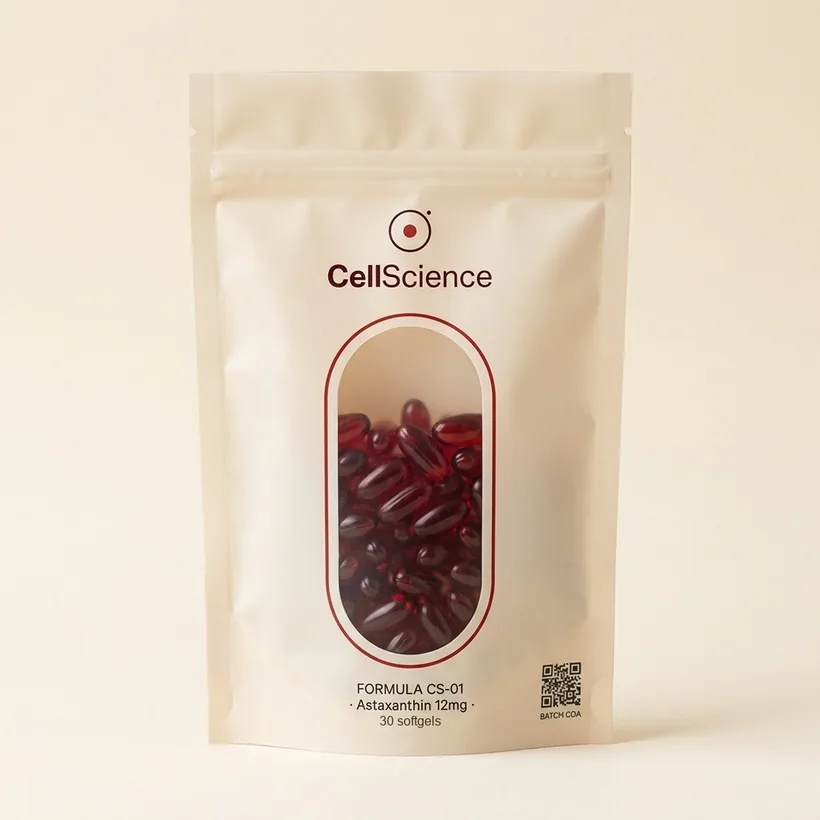
A bag of CellScience Astaxanthin 12 mg softgels
CellScience Astaxanthin: 12 mg of natural astaxanthin in one softgel.
The guaranteetheirs at 67% of the words · ours at 69%
Theirs, in our words
#45at 72%●●●●○2× h2 · img · 90 words

A personal 30-day guarantee: he admits the reader has been burned, puts his promise in writing, and sets a task: take it each morning, have labs drawn on day one, write down two values, energy and how waking feels.

Why it works. Lift the risk off a reader who has wasted money before, and turn the trial into a measured experiment she runs herself. The head puts the guarantee in his name; the picture is its seal. risk-reversalmirroringcommitmentcandorspecificity

Why it sits here, and how it is written

It comes directly after the deadline: the clock made her tense, the guarantee lets her act without fear. The admission that she has been burned comes before the terms, so the terms read as an answer to her history. The day-one task makes her a participant, and someone who has written down a baseline is unlikely to ask for a refund before day thirty.

It opens with plain sympathy and a line about unused bottles at the back of a cupboard, the truest image in the second half. The task is given in short imperatives. Asking for lab draws ties the guarantee to a medical outcome.

Planned for ours, before we wrote: our offer in its place. The 30-Day Money-Back Guarantee, by that name and window (CL-09): full refund, keep the bag. The day-one task transfers as a plain note of how the reader feels; the guarantee is never tied to a lab result.

See these lines on their page ↗
Ours, word for word

What got me to order was the guarantee. It is a 30-Day Money-Back Guarantee, and you keep the bag. The worst case was thirty days and my money back.

r22 row 93
The buttontheirs at 76% of the words · ours at 70%in a different place on their page
Theirs, in our words
#51at 81%●●○○○2× h2 · img · 25 words

A head promises the exact next steps; after a picture, step one tells her to press the button below and gives its label, and step two tells her to pick a package, noting that a flash sale ends today.

Why it works. Replace a decision with a procedure: she no longer has to decide to buy, only to follow numbered steps. easecommitmenturgency

Why it sits here, and how it is written

After the emotional peak the page drops into instructions, and the change of register is the point: feeling has done its work, now the hands need to know what to do. The steps come before the button so that when it appears she has already rehearsed pressing it.

The button's label is about checking stock, not buying, a softer ask that also implies scarcity. The note that the sale ends today contradicts the 72 hours given at entry 44. The line spends its words on where the button is, which the vendor chief counts as furniture (point 015).

Planned for ours, before we wrote: kept the move. A short numbered path to the order transfers. Our button names what is on the other side, in the one CTA vocabulary of the funnel, with the noun where the space allows (CL-16).

See these lines on their page ↗
Ours, word for word
Try The Cell Shield
30-Day Money-Back Guarantee · Free US shipping
What happens, week by weekours at 70%ours only
Theirs, in our words

Nothing on their page does this job here.

Ours, word for word
What I felt, week by week, on one softgel a day

I told myself I'd tell this part straight. I had already paid for one bottle that promised “complete.”

You can't feel your kidneys, so I wrote down what I could feel.

Week one: nothing. I took one softgel with breakfast and felt the same. I had expected that, because you don't feel a shield.

b9 row 98

What did change was me. For the first time since that Tuesday, I was doing more than waiting.

Week two. Three o'clock came and I wasn't heading for the couch. I got through supper and the dishes without sitting down. My afternoons were the first to change.

r7 row 100

Week four. The small print on my pill bottles stopped making my eyes burn. I hadn't even bought the softgel for my eyes.

b6 row 101

Week six. My stomach was calmer after dinner, with less bloating. I'd forgotten what a quiet stomach felt like.

r8 row 102
Proof: other peopletheirs at 48% of the words · ours at 75%in a different place on their page
Theirs, in our words
#33at 52%●●●○○2× h2 · img · 36 words

A head claims doctors are privately ordering it for themselves; after a picture, one sentence gives the time since launch (11 months) and the number of buyers from the community (13,900), and announces the results.

Why it works. Move from how it works to whether it works, with a crowd size and a hint that insiders already use it. social-proofconsensusspecificityborrowed-authority

Why it sits here, and how it is written

It follows the formula because ingredient claims raise the question of real-world results. The head's insider hint reverses the page's enemy: the same profession said to hide the cure is said to buy it, which tells the reader the knowledge is real. The buyer count must precede the percentages so that they read as shares of a large group.

The head is a curiosity line doing proof work. The count is given to the hundred, which reads as measured. FABRICATION: the same count and the same 11 months appear on the other store under another brand name, so neither is a measurement.

Planned for ours, before we wrote: rewritten to our claims. A real customer count, stated as an exact four-digit figure (CL-11), and the longevity doctor's recommendation only if that doctor is real and operator-confirmed (CL-14). No hint that doctors secretly buy it. r19

See these lines on their page ↗
#34at 54%●●●●○6× p · 70 words

Six result lines, each a number with a time window: shares reporting more energy and less foam, an average drop in ankle size, an average gain in eGFR points, a share who cut a medication under supervision, a symptom score.

Why it works. Turn the stories into statistics, one for each sign the page has named, so the reader can pick the number that matters to her. social-proofspecificityconsensusfuture-pacing

Why it sits here, and how it is written

It needs the buyer count above it and the stories before it: numbers first would be cold, stories alone would be anecdote. The order runs from the soonest and softest result (energy at two weeks) to the hardest (medication at ninety days), so belief is stepped up line by line.

Every line has a number, a unit and a window, the form of a trial readout. The measure in inches is the clever one: a tape measure is something she owns. The supervision clause is the only hedge on the page. FABRICATION: no method, sample or source is given, the same six figures serve two brands, and all six are lab or drug outcomes no seller could verify.

Planned for ours, before we wrote: our proof in its place. Our consumer-panel block, from our own panel, the numbers signed off before use. Felt outcomes with windows (energy in the first two weeks), never lab points, body measurements or medication changes. r17r7

See these lines on their page ↗
#35at 55%●●●○○h2 · 53 words

He singles out one figure as the most telling: a return rate under one percent, restated as nine in a thousand, mostly blamed on dose timing and fixed by a phone call; then a handoff to users' own words.

Why it works. Offer a number that comes from behavior, not opinion, and defuse even the few failures. social-proofspecificityobjection-preemptcandor

Why it sits here, and how it is written

It follows the percentages because a skeptic discounts what buyers say and trusts what they do with their money. It is set up as the one number that matters, a classic way to make the reader remember a single figure. It returns at entry 47 as the reason the guarantee is safe to give.

Restating the percentage as people out of a thousand makes it picturable. Admitting returns exist reads as candor; explaining them away in the next breath takes the candor back. UNVERIFIABLE: a rate this low is not credible for anything people swallow.

Planned for ours, before we wrote: rewritten to our claims. One behavioral proof transfers as a move. Ours is the published certificate for every batch, reached by the QR code, set against the share of unverified products in the category that fail potency testing. No return rate unless it is measured and signed off. c3c1

See these lines on their page ↗
#36at 56%●●●●○3× p · 177 words

Three five-star testimonials with name, initial and city: one gives eGFR before and after at six weeks and a doctor who reran the labs; one a first creatinine drop in five years; one a skeptic whose wife ordered for him.

Why it works. Let three different readers hear their own doubt spoken and answered by someone like them. social-proofmirroringidentificationspecificityborrowed-authority

Why it sits here, and how it is written

Statistics persuade the head; these come right after to persuade the ear. Each opens on a resistance (tired of being told to slow it down, disappointed many times, refusing to spend again), so the three cover impatience, fatigue and thrift. They close the proof block so that the price section opens on a reader who has just heard yes three times.

Written as speech, with capitals for stress, a doubled question mark and a casual abbreviation; they sound typed on a phone. The astonished doctor from entry 19 recurs in two of the three, which shows one hand wrote them all. FABRICATION: names and cities cannot be checked, the lab values are invented precision, and the same three people praise another brand on the other store.

Planned for ours, before we wrote: our proof in its place. Real reviews only, in senior voices, men and women in their 60s and 70s, each opening on a doubt our reader holds. No lab values, no astonished-doctor story, no invented reviewers. r17

See these lines on their page ↗
Ours, word for word
“You're not dragging by supper anymore,” my husband said. “What changed?”
What happens, week by weekours at 76%ours only
Theirs, in our words

Nothing on their page does this job here.

Ours, word for word

One softgel a day had changed. Nothing else.

b9 row 104

In week seven the patient portal sent me an appointment reminder. I opened it with both eyes.

By then it was a habit, like winding the kitchen clock. One softgel beside the coffee maker, every morning.

b9 row 106
What the page admitsours at 77%ours only
Theirs, in our words

Nothing on their page does this job here.

Ours, word for word
What one astaxanthin softgel a day will not do

The Cell Shield is not a medicine. One softgel a day does not replace your doctor, your tests, or anything you've been prescribed.

r27 row 108

And nobody should promise you what a softgel will do to a number on a lab sheet. I won't.

I kept my six-month date. I told my doctor everything I take. If you take blood thinners, or have a diagnosed kidney condition, ask your doctor before you start.

r27r28 row 110
The scene aheadtheirs at 69% of the words · ours at 80%
Theirs, in our words
#46at 74%●●○○○3× p · 41 words

Three lines of what the thirty days will show: lab values improving at last, energy lasting through the morning, and the look on her doctor's face when asking what she changed.

Why it works. Fill the guarantee period with pictures of success so the refund feels unlikely to be needed. future-pacinghopevindicationmirroring

Why it sits here, and how it is written

It sits inside the guarantee, between the task and the terms. The task told her what to measure; these lines tell her what she will find. The doctor's astonishment, used at entries 19 and 36 for other people, is now promised to her, and that is the reward the page has been building: being proved right in the exam room.

Two of the three lines repeat entry 17 nearly word for word, the clearest case of the page recycling itself. The third is new and is the strongest: it promises vindication, not health.

Planned for ours, before we wrote: rewritten to our claims. Pictures of the first thirty days from what the gate holds: energy that lasts through the day in the first two weeks, a clearer head. The reward of being proved right transfers as a feeling, never as a promised lab result or a doctor's reaction. r7r6

See these lines on their page ↗
Ours, word for word
My next kidney test

Six months after that first sheet, I sat in the same chair.

This time I hadn't spent the week dreading the email. I had spent six months doing something.

My doctor read the new sheet line by line, and I watched her face. Then she set the next date, six months out. We are still watching.

I left with a date on a card, the same as the first time. But I had walked in steady, and that was new.

That night I left my laptop shut. I had nothing left to look up at two in the morning.

For months I had been a woman who waits. Tested, watched, told to come back. My mood hung on one number. I have a garden and two grandsons to keep up with. I'd rather be a woman who does something.

r24 row 117

My body had not turned on me. It needed help in a place I couldn't reach.

The closetheirs at 71% of the words · ours at 86%
Theirs, in our words
#48at 76%●●●○○2× h2 · img · 25 words

A head says this choice will shape her next ten years; after a picture she is placed where two roads part, and the first road, carrying on as before, is announced.

Why it works. Reduce a complicated decision to two roads, and start with the one she is on. contrastloss-aversioncommitment

Why it sits here, and how it is written

Everything needed to buy has been given: cause, proof, price, deadline, guarantee. The remaining opponent is inertia, and a two-road frame makes doing nothing a choice with a name. The first road is described first so that the second arrives as relief.

The head's time span (a decade) is the largest on the page and matches the ten-year picture at entry 50. The two-roads device is the oldest close in direct response. It is used here without a twist.

Planned for ours, before we wrote: kept the move. Two roads transfer: keep waiting for the next panel, or do one small thing each day between panels. Doing nothing is named as a choice, without contempt for the reader. r10b9

See these lines on their page ↗
Ours, word for word
Two ways to spend the six months before your next kidney test

You can do what I did at first. Drink the water. Read the labels. Hold your breath when the email comes.

Or you can watch and protect at the same time. Keep your appointments. And put a guard where the rust starts, inside your kidney cells. That guard has a name, The Cell Shield, and it takes one softgel a day.

r10m2 row 121
What is at staketheirs at 72% of the wordstheirs only
Theirs, in our words
#49at 77%●●●○○4× p · 58 words

Four lines that open on the same verb, listing what the first path continues: monthly drug spending that never reaches the cause, tiredness before the first coffee is finished, missed family events, and joyless restricted meals while values fall anyway.

Why it works. Price the status quo in money, energy, family and pleasure, so staying put feels like spending. loss-aversionfear-of-declinemirroringspecificity

Why it sits here, and how it is written

It sits inside the first road, before the ten-year picture. It lists present losses she can verify today; the future threat at entry 50 is only believed if the present ones ring true. The four items are the four parts of the page in miniature: the bill, the symptoms, the scene, the diet.

One verb opening every line makes the list feel like a treadmill. The coffee detail is the best: it gives fatigue a clock. The missed family events touch the reader's real fear more than any lab value.

Planned for ours, before we wrote: rewritten to our claims. Present costs our reader can verify today, in the reader's own words: the six months of waiting, the noon crash, the shelf of bottles. No drug spending, no restricted diet, no line that makes past choices look foolish. r7r23

See these lines on their page ↗
Ours, word for word

Nothing on our page. The plan on the left says why.

The guaranteetheirs at 70% of the words · ours at 88%in a different place on their page
Theirs, in our words
#47at 75%●●●●○h2 · 64 words

The terms: if after thirty days she cannot say her labs improved, a full refund with shipping, no forms or store credit, by an email to a support address containing one word. His confidence rests on the return rate, repeated.

Why it works. State the refund so simply that asking for it sounds effortless, then show the seller expects few to ask. risk-reversaleasespecificitysocial-proofreason-why

Why it sits here, and how it is written

It is last in the guarantee, after the pictures of success, so the refund is read by someone already imagining she will not need it. The return rate planted at entry 35 comes back as the reason the promise is affordable. With risk removed, the only thing left between her and the button is delay, which the close attacks next.

Three short negations, then the refund procedure reduced to a single word in an email. The exaggerated count of questions is a small comic touch in the narrator's voice. The refund condition is phrased as a thought about lab results in an exam room. UNVERIFIABLE: the return rate.

Planned for ours, before we wrote: our offer in its place. Our terms in the same plain register: thirty days, full refund, keep the bag, how to ask. The window and the name never vary across the funnel (CL-09). No return rate quoted unless measured.

See these lines on their page ↗
Ours, word for word
How to run your own 30-day test of one softgel a day
r22 row 122

Trying it is the easy part, because the 30-Day Money-Back Guarantee covers the test. Don't take an ad's word for it, and don't take mine. Run your own test, in your own kitchen.

r22 row 123
How to take itours at 90%ours only
Theirs, in our words

Nothing on their page does this job here.

Ours, word for word

Today. Choose how to start. One bag is a one-time order. The free trial turns into a monthly plan, and one click cancels it.

r31 row 124

Every morning. One softgel, with a meal that has some fat in it. Eggs, yogurt, half an avocado.

b9r31 row 125
The guaranteeours at 91%ours only
Theirs, in our words

Nothing on their page does this job here.

Ours, word for word

The day your bag arrives. Write down how your afternoons feel. Week four. Read it back. If nothing is better, send one email before day thirty and get your money back. You keep the bag. If you chose the monthly plan, cancel it that day too.

r22 row 126
The scene aheadours at 93%ours only
Theirs, in our words

Nothing on their page does this job here.

Ours, word for word

Then keep your next test on the calendar, and tell your doctor what you take. I can't promise you a number. I can promise you'll walk in having done something.

r10 row 127
The closetheirs at 73% of the words · ours at 94%
Theirs, in our words
#50at 78%●●●●○p · h2 · 154 words

A jab about funding her specialist's car, then the ten-year picture: the machine, three sessions every week. The second path costs less than a meal out, goes at the cause, joins a movement, and leads to a granddaughter's birthday.

Why it works. Set the worst future against the cheapest exit and let the reader name the choice herself. fear-of-declinefuture-pacingcontrastanchoringidentification

Why it sits here, and how it is written

The present losses have just been listed; now comes the future one, the word the page has circled since the scene. Only here, after the guarantee, is it safe to frighten her this much, because the way out is already priced and free of risk. The last line does not tell her which road to take. It says she knows, and ties the answer to a grandchild.

At 148 words it is the longest block of the two-roads passage. The meal comparison returns from entry 42 and the car jibe from entry 10. The final sentence is the emotional peak of the page: a family event in the future, the reverse of the missed ones at entry 49. The prophecy of the machine is a medical threat made to a sick reader.

Planned for ours, before we wrote: rewritten to our claims. The closing picture transfers as a family moment the reader wants to be present and strong for: aging with strength, clarity and independence. No prophecy of illness, no machine, no movement against anyone. r24

See these lines on their page ↗
Ours, word for word

You've stayed with me this long, and I think I know why. You're tired of only watching, the way I was. Three short questions come next.

The offertheirs at 77% of the wordstheirs only
Theirs, in our words
#52at 82%●●●●○3× p · 53 words

Three package lines: one bottle at 29.99, marked 60 percent off, enough for two weeks' felt change; buy two get one free at 59.99, flagged most popular; buy three get two free at 89.99, flagged best value.

Why it works. Offer three sizes so the question shifts from whether to buy to how many. anchoringsocial-proofspecificitycommitmentcontrast

Why it sits here, and how it is written

It appears only after steps one and two have been announced, so the ladder is read as step two of a procedure she is already in. The single bottle is priced to make the three-bottle line look like the sensible middle, and the label of popularity tells her what people like her choose.

Per-bottle prices are given on the bundles, which does the division for her. The top line says five bottles are enough to guarantee results, a promise of outcome inside a price list. The entry price here is ten dollars below the price the body announced at entry 41, and the other store runs a different ladder under the same body copy.

Planned for ours, before we wrote: our offer in its place. Our ladder has the same shape and nearly the same figures: 1 bag 29.99, buy 2 get 1 free 59.97 (most popular), buy 3 get 2 free 89.95 (best value, lowest price ever), free shipping on each. Figures mirror the live checkout (CL-10). No line promising that a larger bundle guarantees a result. x4

See these lines on their page ↗
Ours, word for word

Nothing on our page. The plan on the left says why.

Urgencytheirs at 78% of the wordstheirs only
Theirs, in our words
#53at 83%●●●○○h2 · 247 words

One block: a note selling automatic refills at a third off with priority when stock runs low; steps three to six (shipping, delivery, a quarter-teaspoon dose, emailing him her story); then a passage redefining waiting as further decline.

Why it works. Upgrade the order to a subscription, finish the procedure past the purchase so ownership is imagined, then shut the door on postponement. loss-aversionurgencyeasecommitmentfuture-pacingfear-of-decline

Why it sits here, and how it is written

The subscription pitch sits inside step two, at the moment of choosing a package, where an add-on costs least attention. Steps five and six happen after delivery: by describing the first dose and the thank-you email, the page has her already owning it. The passage against waiting is the last prose before the button because postponement is the last objection left.

Three jobs share one 247-word block and the seams show. The refill note is the only place the page speaks like a store. The waiting passage works by repeating one quoted word three times and redefining it each time, then two sentences built on the same closing phrase. Asking for her success story before she has bought is a bold presumption that works. The dose is the only usage instruction on the page.

Planned for ours, before we wrote: rewritten to our claims. Three parts, three fates. The refill pitch is dropped: we run no subscribe-and-save (r21 is false). The usage line becomes ours: one softgel a day with a meal that has some fat. The passage against waiting is rewritten around the six months between panels, with no threat of falling values. b9r31r10

See these lines on their page ↗
Ours, word for word

Nothing on our page. The plan on the left says why.

The buttontheirs at 83% of the words · ours at 95%
Theirs, in our words
#54at 86%●●●●●cta · 3 words

The first button on the page, at 86 percent of its height: two words inviting her to check availability, with an arrow, linking to the store's product page.

Why it works. Take the click. scarcityeasecommitment

Why it sits here, and how it is written

Nothing above it could be clicked. The page withholds the button until the whole case, price, deadline, guarantee and procedure are delivered, so every click comes from a reader who has heard everything. The cost is every reader who was ready at the name (entry 24) and still had about 15,000 pixels to scroll.

The label asks a question about stock instead of asking for money: a small yes. It matches the step-one instruction exactly, which is good procedure. One button style, one destination.

Planned for ours, before we wrote: kept the move. One label, one destination, matching the instruction above it (CL-16). We do not inherit the late placement: our chassis carries a sidebar card and a sticky button, so a reader who is ready at the reveal can act.

Open on their page ↗
#55at 86%●●●○○img · h2 · cta · 22 words

A picture, then a display line shouting the 60 percent discount by product name and limiting it to three days, then the same button again.

Why it works. Catch the reader who scrolled past the first button, with the offer restated in one glance. urgencyanchoringease

Why it sits here, and how it is written

A second chance placed one screen below the first, for the thumb that kept moving. It restates only price and deadline because at this depth nothing else is in doubt.

Banner register, exclamation marks, the voice of a template and no longer of the narrator. The three days stated here are the third version of the deadline (72 hours, today, three days).

Planned for ours, before we wrote: kept the move. A second button one screen below the first, with the offer in one line. One deadline, stated one way everywhere, and only if it is real.

See these lines on their page ↗
Ours, word for word
Answer 3 questions and SAVE UP TO $210!
  1. What do you most want to protect?
  2. How do most afternoons feel?
  3. What do you take every day now?
Save up to $210 →
Save $210 is the 5-bag price: $17.99 a bag instead of $59.99. Every order has the 30-Day Money-Back Guarantee.
The offertheirs at 84% of the wordstheirs only
Theirs, in our words
#56at 88%●●○○○h2 · img · 2× p · 39 words

A boxed offer in capitals: internet only, a small square picture, 60 percent off plus shipping paid by the seller (referred to in the third person), a reader-only special capped at 500 buyers.

Why it works. Add the look of an editor's deal box, as if the publication had negotiated a reader discount. exclusivityscarcityurgencyborrowed-authority

Why it sits here, and how it is written

It comes after the buttons, as the last block of the article proper. It switches voice to a third party so that the discount appears to be vouched for by the journal from entry 1, closing the editorial frame the masthead opened.

The template shows through: the seller is spoken of in the third person inside a first-person letter, and the cap of 500 buyers is a third stock figure. This block belongs to the advertorial template and was not rewritten for this letter.

Planned for ours, before we wrote: our offer in its place. The house offer box, in the house voice, with free shipping stated as we give it and sold only on our own site. No cap on buyers, no switch of voice. r29

See these lines on their page ↗
Ours, word for word

Nothing on our page. The plan on the left says why.

The doubt, answeredours at 95%ours only
Theirs, in our words

Nothing on their page does this job here.

Ours, word for word

P.S. You may wonder why your doctor never brought this up. I asked mine. A doctor watches and prescribes. A softgel made from microalgae isn't a prescription, so it isn't on her list.

The closetheirs at 85% of the words · ours at 96%
Theirs, in our words
#57at 89%●●●○○h2 · 141 words

A text link, a sign-off as the product's creator, and three postscripts: the wife standing through a grandson's birthday, a stock count of 832 with a threat to pull the page, a dare to doctors citing 837 cases.

Why it works. End the letter as a letter, and give the three kinds of late reader (the moved, the hesitant, the hostile) one last line each. loop-closedfuture-pacingscarcityurgencycommon-enemyearned-authority

Why it sits here, and how it is written

Postscripts are read by people who skip to the end, so each restates one argument in miniature: the story, the scarcity, the fight. The wife returns a third time, now in the present tense of the letter, which closes the loop opened at entry 7 with new evidence. The dare to doctors is last because it speaks over the reader's shoulder to the doubter in her life.

The first postscript is the best writing in the close: a photo, a party, three hours standing, then the offer to the reader in one short sentence. The second contradicts two earlier stock figures. The third cites a number of cases that matches nothing else on the page. FABRICATION: the same doctor signs as creator of a differently branded product on the other store.

Planned for ours, before we wrote: rewritten to our claims. A signed close and one postscript that returns to the scene's object transfers. Ours closes on independence and being present for family. No stock countdown, no dare, no case count; the signer is real or a disclosed composite (CL-14). r24

See these lines on their page ↗
Ours, word for word

That doesn't make watching wrong. It just leaves you six months with nothing to do. What you do at your own breakfast table was always yours to decide.

Reader commentstheirs at 88% of the wordstheirs only
Theirs, in our words
#58at 91%●●●○○p · 2× h3 · 4× li · img · 70 words

The thread opens under a one-word label: a first commenter wants in if it helps her numbers and says the quarterly drop exhausts and frightens her; a second reports lasting through the day now, photo attached.

Why it works. Show the first two positions a reader can take: wanting it, and having it. social-proofmirroringidentificationhope

Why it sits here, and how it is written

It sits below the signature, where the article ends and the reader's own reaction begins. The first voice is a non-buyer, so the thread does not open as an advertisement; the second is a buyer with a photo, so desire is answered at once by evidence.

Dressed as a social feed: name, reaction line, like count, age in minutes or hours. Names are chosen for the community the page addresses, and every voice uses the page's own vocabulary. FABRICATION: a scripted thread. The same seventeen names, comments, like counts and ages appear on both stores, with only the brand name changed.

Planned for ours, before we wrote: left out. An invented thread does not transfer. The two positions it stages (wanting it, having it) are covered by real reviews in senior voices and by the angle's real voice-of-customer file.

See these lines on their page ↗
#59at 93%●●●○○2× h3 · 4× li · 87 words

One commenter complains about her daily pill count and would buy if spared it; the next agrees, reports a doctor's call after labs urging her to continue, and a first creatinine drop in three years.

Why it works. Raise the pill-burden objection in a reader's mouth and have another reader answer it with a result. objection-preemptsocial-proofmirroringborrowed-authority

Why it sits here, and how it is written

Question and answer pairs are the engine of the thread. This pair comes early because pill fatigue is the reader's daily irritation and the product is a liquid: the objection is one the product wins. The doctor's approval arrives in the reply, the same device as entries 19 and 36.

The reply opens by echoing the complaint, which is how real replies sound, and it is timed an hour after the comment it answers, a detail done right. FABRICATION: a scripted thread. The same seventeen names, comments, like counts and ages appear on both stores, with only the brand name changed.

Planned for ours, before we wrote: left out. Invented thread. The objection is real for our reader (one more pill?) and is answered in our own copy: one softgel a day in place of a shelf of bottles. b9r23

See these lines on their page ↗
#60at 94%●●●○○3× h3 · 6× li · 128 words

A worried commenter follows every instruction and still declines; another asks if anyone has tried it for kidney trouble; a third answers: six weeks in, better than drugs that only mask values, eGFR up nine points, recommended.

Why it works. Voice the compliant patient's despair and the request for real experience, then supply the experience with a number. mirroringvindicationsocial-proofspecificityobjection-preempt

Why it sits here, and how it is written

It is mid-thread, where a reader who is still unconvinced is looking for someone like her. The request for real users is the reader's own question typed out; placing the answer directly beneath makes the thread seem to work as a community.

The question uses a casual word for the product, a touch that sounds unscripted. The answer names a gain of nine points against the page's claimed average of 8.3, so the thread agrees with the stats panel a little too well. FABRICATION: a scripted thread. The same seventeen names, comments, like counts and ages appear on both stores, with only the brand name changed.

Planned for ours, before we wrote: left out. Invented thread. The compliant patient who still drifts is the heart of our angle and belongs in the body copy; the request for real experience is met by real reviews. r10

See these lines on their page ↗
#61at 96%●●○○○4× h3 · 8× li · 105 words

One commenter hopes it is as simple as claimed since she already manages a lot; another worries about a medicinal taste; two replies reassure her that it is pleasant, one likening it to honey.

Why it works. Handle the two practical objections the article never raised: effort and taste. objection-preempteasesocial-proofconsensus

Why it sits here, and how it is written

These are small objections that would sound petty in the doctor's voice, so they are given to readers. They come after the results comments because a reader only asks about taste once she is picturing herself taking it, which is itself a sign of intent.

The taste exchange is the most natural-sounding part of the thread: short, lower case, one exclamation. The simplicity comment has the most likes in the thread, a quiet signal of what the writer thinks matters most. FABRICATION: a scripted thread. The same seventeen names, comments, like counts and ages appear on both stores, with only the brand name changed.

Planned for ours, before we wrote: left out. Invented thread. The practical objections move to our FAQ with true answers: how to take it (with a meal that has some fat), allergens and age. r31r27

See these lines on their page ↗
#62at 97%●●●○○3× h3 · 6× li · 86 words

Two short raves (a specialist smiling at results for once; values she never expected to see again), then a commenter who doubted the video, was persuaded by the thread itself, and says she is ordering today.

Why it works. Model the conversion: show a skeptic changing her mind because of the very comments the reader is reading. social-proofconsensuscommitmentvindication

Why it sits here, and how it is written

It comes near the end of the thread, after the objections have been answered. The persuaded skeptic is the reader's stand-in, and her decision gives permission. She mentions a video, which tells us the page expects many readers to have watched and not read.

The smiling specialist is a gentler version of the astonished doctor, used yet again. By the ages shown, the commenter convinced by the thread posted five hours ago, before nearly all of the comments she says convinced her. FABRICATION: a scripted thread. The same seventeen names, comments, like counts and ages appear on both stores, with only the brand name changed.

Planned for ours, before we wrote: left out. Invented thread. The stand-in skeptic is a strong device and can live honestly in a real review that opens on doubt.

See these lines on their page ↗
#63at 98%●●○○○3× h3 · 6× li · img · 105 words

A commenter asks whether it truly moves the numbers; a two-month user answers with eGFR from 29 to 38, brain fog nearly gone and praise for fast customer service; the last says hers arrived today, above a final photo.

Why it works. Answer the one question that matters in the reader's own words, vouch for the seller's service, and end on a package arriving. social-proofspecificityobjection-preemptfuture-pacingrisk-reversal

Why it sits here, and how it is written

It is last in the thread and on the page. The numbers question is the whole page in six words, saved for the end so that the final proof she reads answers it. Service praise supports the refund promise. The arrival comment ends the page on the moment after purchase, which is where the seller wants her imagination to rest.

The asking comment ends with an invitation that belongs to someone answering questions, not asking them: a pasted line from another script. The arrival comment is the most believable line in the thread because it claims nothing. The photo has no alt text. FABRICATION: a scripted thread. The same seventeen names, comments, like counts and ages appear on both stores, with only the brand name changed.

Planned for ours, before we wrote: left out. Invented thread. Ending the page on the moment after purchase transfers as a move: our last block can show the bag arriving and the first softgel taken with a meal. b9r31

See these lines on their page ↗
Ours, word for word

Nothing on our page. The plan on the left says why.

What the page admitsours at 97%ours only
Theirs, in our words

Nothing on their page does this job here.

Ours, word for word

One last thing, because I'd want to know. Most people take astaxanthin without any trouble. If you have a diagnosed kidney condition, or you take blood thinners or other medicines, ask your doctor or pharmacist first. The same goes if you are pregnant or nursing.

r27r28 row 132
Proof: the researchours at 99%ours only
Theirs, in our words

Nothing on their page does this job here.

Ours, word for word
Every study the story leans on, with what kind of evidence it is. The kept page lists its sources the same way.
What I read
  1. Review. The aging kidney and oxidative stress in its blood vessels. Acta Physiologica Hungarica, 2007. PubMed 17444279
  2. Lab study on kidney cells, not people. Astaxanthin and the cell's own defenses under high sugar. Marine Drugs, 2018. PubMed 29621130